
LSO Location Search Optimization
Own the local 3-pack.
LSO is the discipline of winning visibility in geographically scoped search — the Google local 3-pack, Maps, and “near me” queries. For service businesses, it’s the highest-ROI channel in the stack.
LSO Location Search Optimization
Own The Local:
3- Pack

What Is LSO?
Here’s The Two Sentence Definition:
LSO is the discipline of winning visibility in geographically scoped search results — the Google local 3-pack, Google Maps, Apple Maps, and “near me” queries.
It is a different optimization stack from traditional SEO: GBP completeness, citation network consistency, review velocity, and proximity drive local rankings, and most of it is operational rather than editorial.
For service businesses (HVAC, roofing, dental, legal, CPA, med spa), LSO is usually the highest-ROI discipline in the marketing stack. It is also the one most agencies do worst, because the work is unglamorous: directory hygiene, review cadence, GBP posts.
What Is AEO?
Here’s The Two Sentence Definition:
LSO is the discipline of winning visibility in geographically scoped search results — the Google local 3-pack, Google Maps, Apple Maps, and “near me” queries.
It is a different optimization stack from traditional SEO: GBP completeness, citation network consistency, review velocity, and proximity drive local rankings, and most of it is operational rather than editorial.
For service businesses (HVAC, roofing, dental, legal, CPA, med spa), LSO is usually the highest-ROI discipline in the marketing stack. It is also the one most agencies do worst, because the work is unglamorous: directory hygiene, review cadence, GBP posts.
The Three Surfaces
The Three Pillars of SEO Success

On-Page Optimization
Structuring individual pages to rank for target keywords. This includes title tags, meta descriptions, header hierarchy, keyword placement, internal linking, and content depth. Each page should target a primary keyword and 2–3 related terms.

Technical SEO
Ensures search engines can crawl, index, and understand your website. Site speed, mobile responsiveness, SSL certificates, XML sitemaps, robots.txt files, and structured data markup all impact how well search engines process your content.

Off-Page Authority
Builds your domain’s credibility through backlinks from other reputable websites. Quality backlinks from relevant, high-authority domains signal to Google that your content is trustworthy and valuable enough to reference.
The Shift
The Search Revolution
That’s Leaving Businesses Behind:
Backlinks still matter — especially from locally relevant domains — but these five do the heavy lifting in the local pack.
~50%
of all Google searches have local intent
5×+
Growth in ‘near me’ queries over the last decade

76%
of local searchers visit a related business within 24 hours
28%
of those visits convert to a purchase
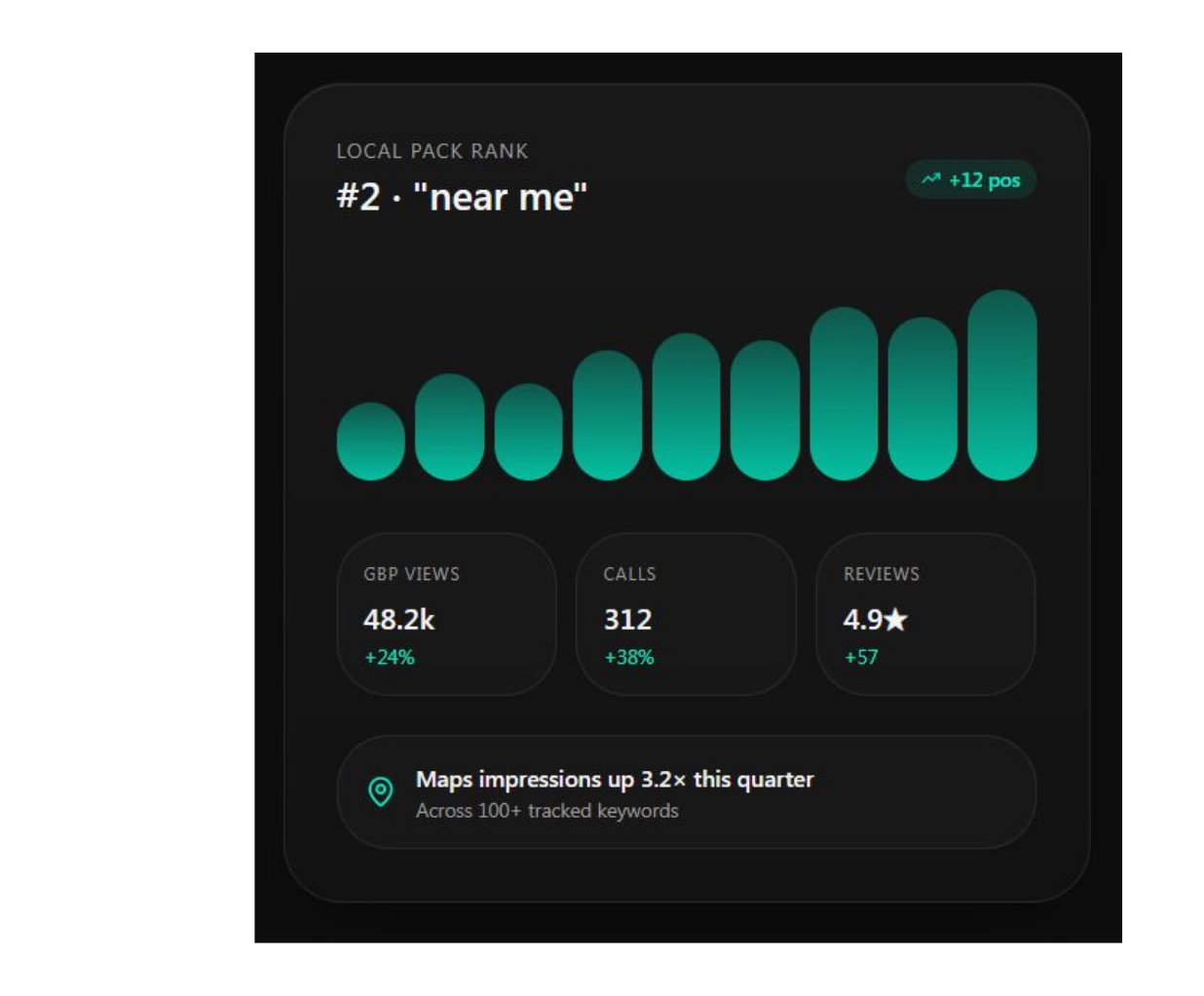
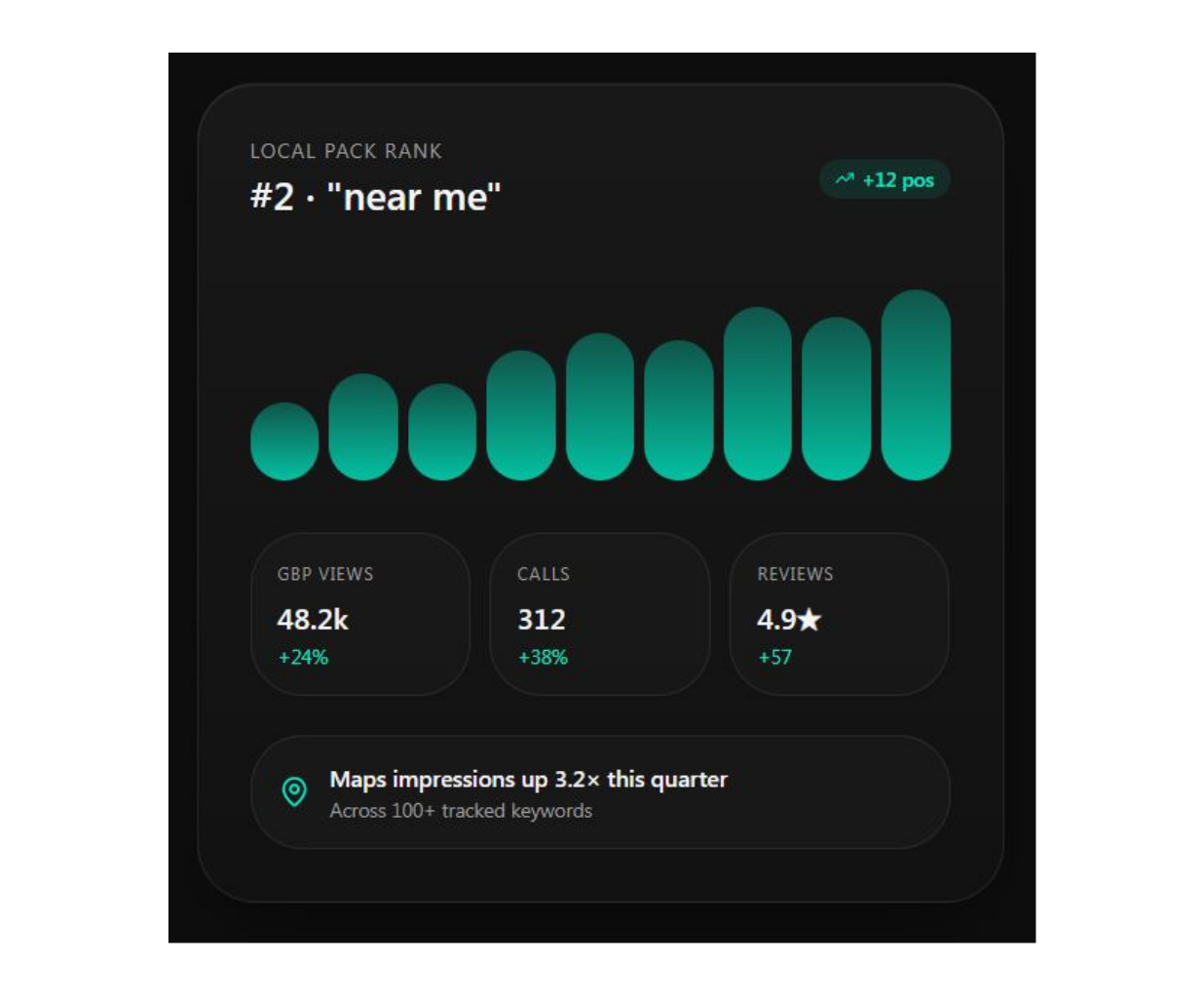
Translation: the local 3-pack is not a vanity ranking. It is a queue of qualified leads who have already raised their hand. Ranking in it is the closest thing to free money in modern marketing.
The Outcome
The five LSO signals that actually Move Rankings

GBP Complete & Category Defined
Google Business Profile is your business’s local face. Primary category, secondary categories, hours, services, products, and photos — every missing field suppresses rankings.

NAP Consistency Across Citations
Yelp, BBB, Apple Maps, Bing Places, Yellow Pages, Angi, HomeAdvisor, Foursquare. Even tiny differences (suite vs. unit, with/without Inc) confuse Google’s matching.

Review Count & Consistency
Total reviews signal trust; review velocity signals ‘still in business.’ Both feed local ranking. Replies to reviews compound the effect.

Proximity
Closer to the searcher = better ranking, holding other factors constant. You can’t move your office, but you can mitigate it with stronger signals everywhere else.

On-Page Local Relevance
City names, neighborhood names, ZIP codes, and service areas in on-page content — and in your GEO-shaped articles — tell Google which queries you should match.
The Framework
Your Winning To-do List
LSO rewards consistency more than brilliance. The businesses that dominate their local pack are not the ones with the cleverest content — they are the ones that show up to the work every week.

GBP Posts and Photos
Google measures GBP activity. A posting cadence (offers, news, photos) signals an active business and lifts ranking. Most competitors set up your GBP and never touch it again. (This is a weekly task.)
Review Solicitation
A consistent ask — by SMS or email — to every customer who completed service. Steady review velocity beats sporadic spikes. Always reply to every review, positive or negative. (At least weekly, best right after service is completed).
Citation Audit
Once a month, scan the major directories for NAP drift. New franchise listings, duplicate listings, address changes, and zombie citations all need cleanup.
Local Relevant Content
Blog posts targeting local queries: neighborhood guides, service-area pages, “best of [city]” formats. Each piece is a relevance signal Google maps to your service area. (Add at least one of these each month.)
GBP Optimization
New service categories, updated descriptions, expanded service area, refreshed photos, FAQ updates. Google rewards GBP profiles that change because static profiles signal a static (or closed) business. (This is a quarterly exercise.)
Rank Tracking
Track 3-pack and Maps rankings for your top 50–100 keywords weekly. Without tracking, you cannot tell which interventions worked, and you cannot prove ROI to yourself or to anyone else.
The Advanced Ranking Core® Solution
We run your LSO cadence – end to end.
ARC manages the LSO operational cadence for you. Combined with our GEO and AEO coverage, you stay visible on Google, ChatGPT, Perplexity, Gemini, Maps, and voice search.
GBP optimization & weekly posts
NAP-consistent citation building across 20+ directories
Weekly review-solicitation flows
Continuous rank tracking on 100+ keywords
Integrated AEO + GEO + LSO coverage
Frequently Asked Questions About LSO

What is the difference between LSO and regular SEO?
Regular SEO competes for the ten organic results on a results page. LSO competes for the three slots in the Google local 3-pack and the geographically pinned results on Maps. The ranking signals are different: LSO weights GBP completeness, citation consistency, review velocity, and proximity heavily, where regular SEO weights backlinks and on-page content.
Do I still need a website if I have a great GBP?
Yes, and increasingly so. Google validates GBP claims against your website’s content. A complete, consistent website that mirrors your GBP categories, services, and service area lifts your local ranking. A missing or inconsistent website caps how much GBP-only optimization can do for you.
How many citations do I need?
For most local service businesses, 20–30 strong, NAP-consistent citations on the major directories (Google, Yelp, Apple Maps, Bing Places, Facebook, BBB, Yellow Pages, Angi, HomeAdvisor, Foursquare, plus industry-specific directories) cover the bulk of the value. Beyond that, returns diminish quickly. Quality and consistency beat quantity.
How fast can LSO move me into the 3-pack?
It depends on starting position and competition. Businesses with a clean GBP and modest existing reviews often move into the 3-pack for medium-difficulty queries within 4–8 weeks. Highly contested markets (HVAC and personal injury law in major metros) take longer — 3–6 months of disciplined cadence.
Can I rank in multiple cities from one location?
Partially. Google heavily weights proximity, so a business with a single physical location ranks best in queries originating near that location. You can extend reach with city-specific service-area pages, neighborhood content, and consistent service-area declaration in your GBP — but to rank reliably in multiple cities, additional physical locations (or a service-area business GBP per city) usually become necessary.