
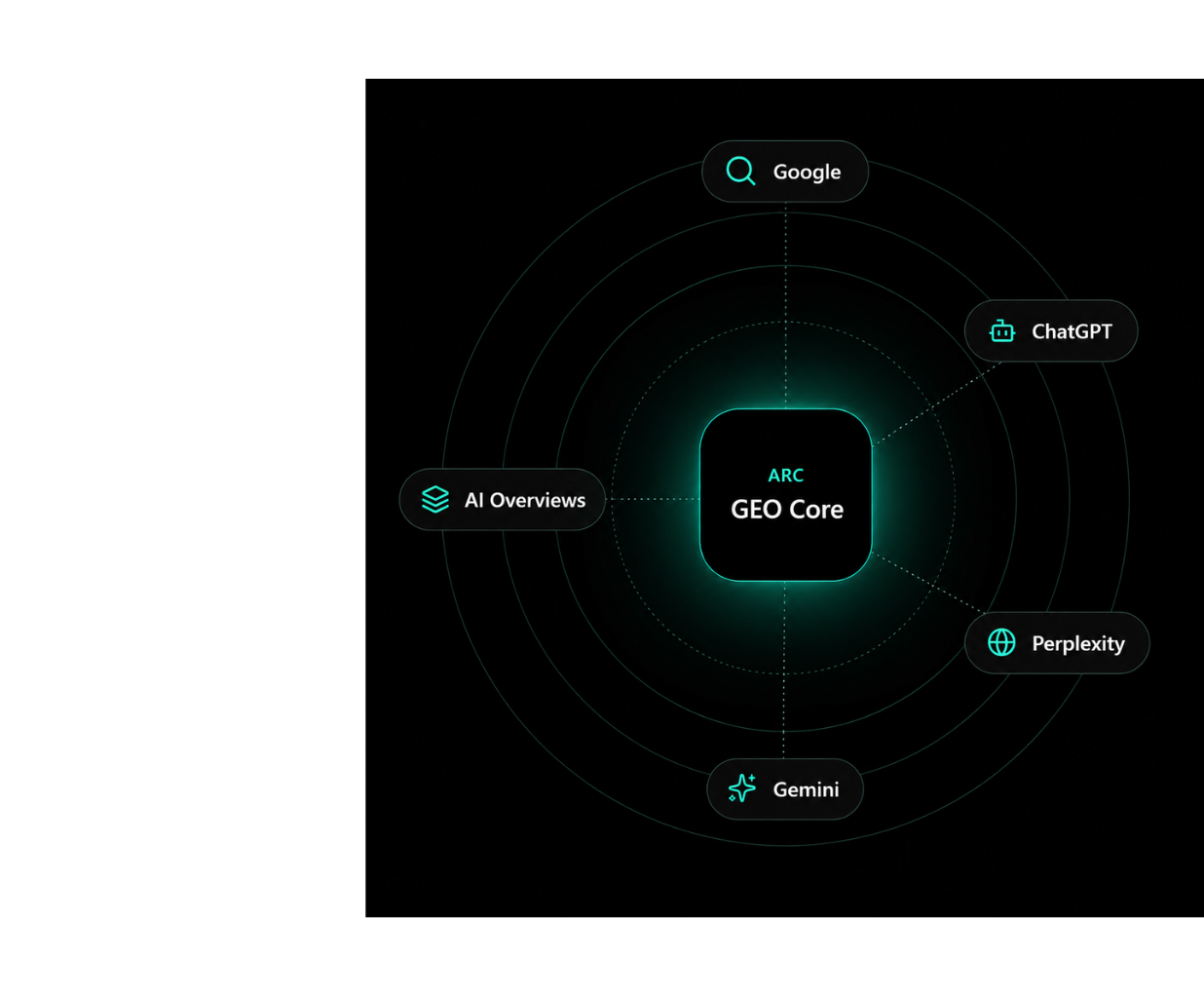
GEO Generative Engine Optimization
Generative Engine Optimization:
The Key to Success at the Top of Your Marketing Funnel
ARC Built for the AI search era
Generative Engine Optimization:
The Key to Success at the Top of Your Marketing Funnel

What Is GEO?
Here’s The Two Sentence Definition:
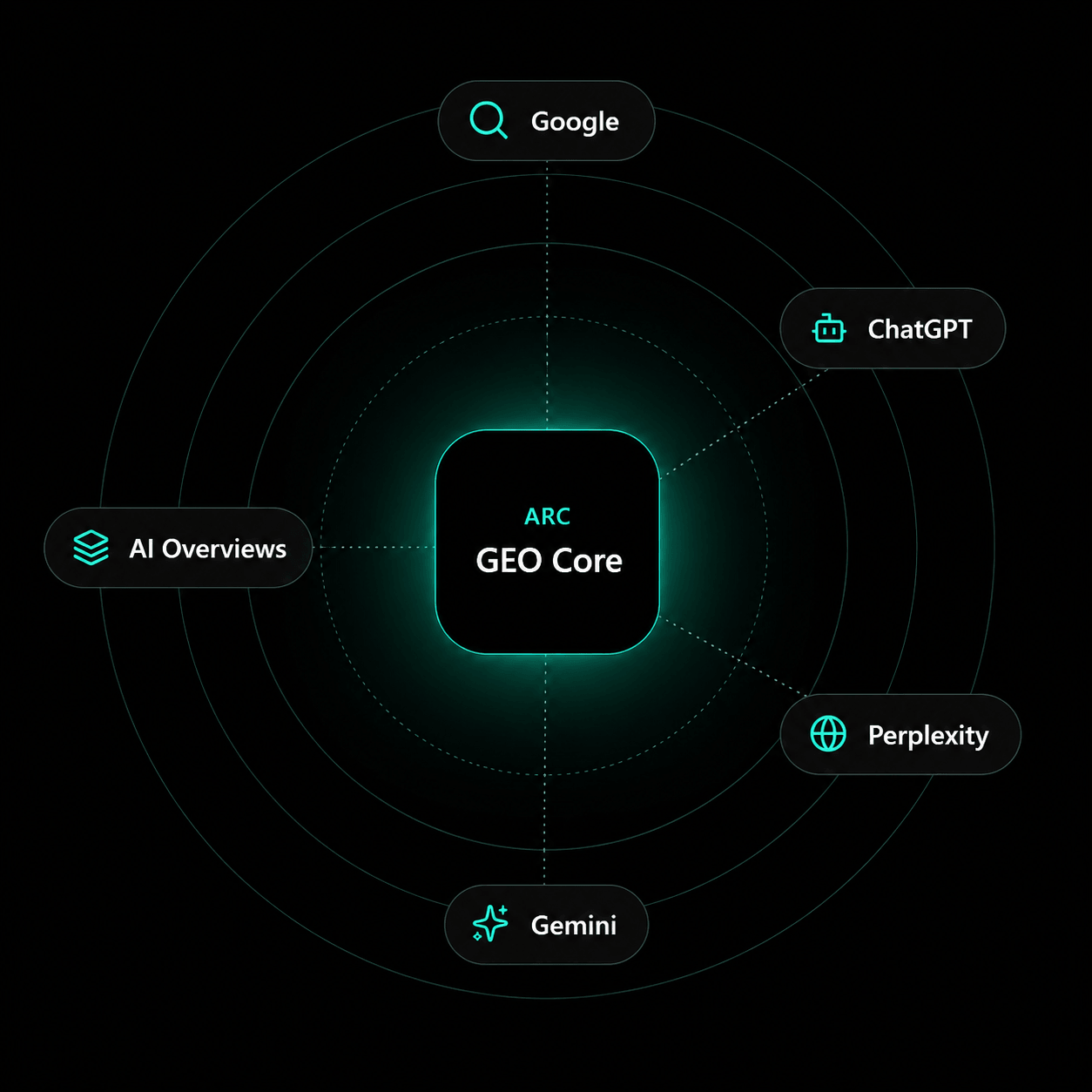
Generative Engine Optimization is the practice of optimizing content so generative AI engines cite it inside their answers.
Where SEO targets a Google ranking that produces a click, GEO targets a citation inside an AI-generated answer that may not produce a click at all — but does produce attribution, brand visibility, and downstream demand.
The two disciplines look similar from a distance and operate on overlapping signals.They are not the same job. Most agencies still treat them as the same job. That is why they fail at Generative Engine Optimization.
What Is GEO?
Here’s The Two Sentence Definition:
Generative Engine Optimization is the practice of optimizing content so generative AI engines cite it inside their answers.
Where SEO targets a Google ranking that produces a click, GEO targets a citation inside an AI-generated answer that may not produce a click at all — but does produce attribution, brand visibility, and downstream demand.
The two disciplines look similar from a distance and operate on overlapping signals.They are not the same job. Most agencies still treat them as the same job. That is why they fail at Generative Engine Optimization.
The Shift
Why Search Today Doesn’t Look Like Yesterday’s Search

Google AI Overviews
Google AI Overviews now appear above the organic results for a large fraction of informational and local queries.
The user reads the synthesized answer and frequently never scrolls.

Commercial intent has moved
For commercial intent queries — “best HVAC company in Tampa,” “what is the cheapest way to get my CPA practice ranked,” “which CRM works for plumbers” — being inside the AI answer is the new “page one.” If your competitor is cited and you are not, the user never sees you. There is no scrolling to find other companies.

Voice & ambient assistants
Voice and ambient assistants resolve queries via the same generative pipelines. There is no SERP to scan — there is one answer, and one or two cited sources.

AI as default research surface
ChatGPT, Perplexity, and Gemini have moved from novelty to default research surface for millions of consumers. Asking an AI for a recommendation now competes with typing a query into Google.
The Framework
How GEO is Different From SEO
Dimension
Goal:
Engine Behavior:
Optimization Target:
Schema Importance:
Content Shape:
Authority Lever:
Update Frequency:
Rank in 10 blue links
Returns a list, user clicks
Keywords + Backlinks
Helpful
Long form, keyword focus
Backlinks
Quarterly is fine
GEO
Be cited inside AI answer
Synthesizes one answer
Entity clarity + question-shaped phrasing + trust signals
Critical — engines parse it directly
Direct-answer-first, question-titled, entity-explicit
Citations + brand mentions across web
Continuous publication compounds Faster
Both still matter. SEO still drives the lion’s share of clicks for transactional queries. GEO drives the brand visibility that precedes those clicks — and increasingly the conversions themselves when the AI answer surfaces a phone number or booking link inline.
The Success Key: Volume
Every tactic below is teachable. The reason most businesses lose at GEO is not technique — it is throughput. To be reliably cited for “best HVAC in Tampa,” you need question-shaped content on:

Neighborhoods
The neighborhoods of Tampa.
Services
The HVAC services (install, repair, maintenance, emergency, commercial).
Brand comparisons
The brand-comparison queries (Carrier vs Trane, Lennox repair).

Near-me & ZIP
The “near me” variants and the ZIP-code variants.
Price points
The price-point queries (“how much does HVAC repair cost in Tampa”).
Seasonal
The seasonal queries (“AC not cooling in summer,” “furnace tune-up in fall”).
We get it
The Advanced Ranking Core® Solution
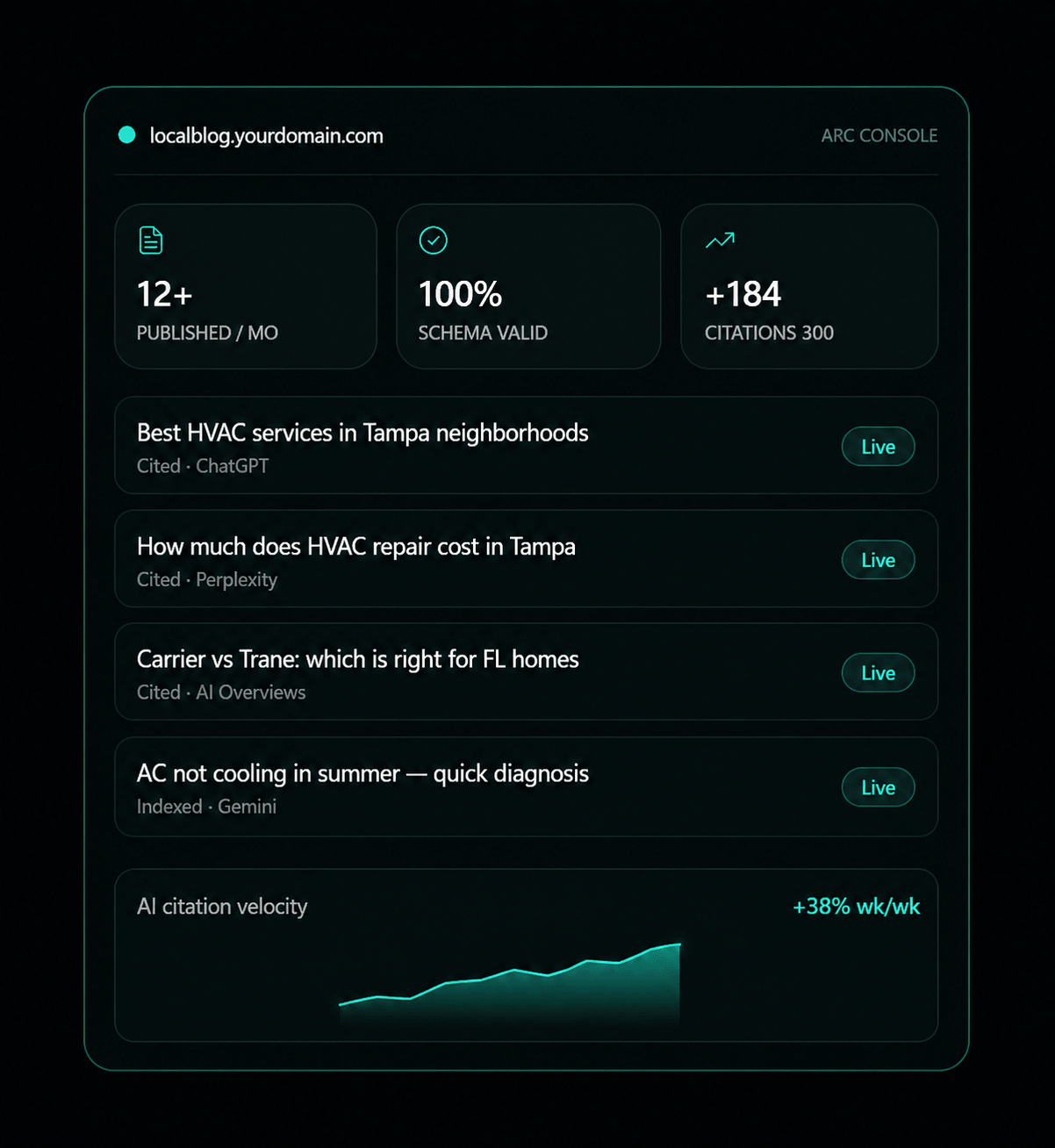
ARC publishes 12+ GEO-shaped articles per month to a dedicated subdomain on your domain (localblog.yourdomain.com), with FAQ schema, article schema, entity disambiguation, and direct-answer-first structure on every piece.
Each article is targeted at a specific question your customers ask, written for both human readability and engine extraction.
Combined with our AEO and LSO coverage, the result is a business that shows up in Google, ChatGPT, Perplexity, Gemini, and Maps for the queries that drive revenue — without you running an editorial calendar.
Frequently Asked Questions About GEO

Is GEO replacing SEO:
No. GEO layers on top of SEO. Traditional Google search still drives the largest share of click-through traffic, but a growing percentage of high-intent commercial queries are being answered inside AI engines without the user ever seeing a SERP. Businesses that ignore GEO are invisible for those queries.
How long does GEO take to work?
Most GEO-optimized content begins receiving citations within 2–4 weeks. AI engines re-crawl more aggressively than Google updates its main index, so citation gains tend to materialize faster than ranking gains — though both compound over time.
Can I do GEO myself?
Yes. The tactical layer is publishable: direct-answer-first structure, question-shaped titles, entity clarity, FAQ schema, specific numbers. The constraint is volume. To win citations consistently you need to publish on every angle of every query you care about, every month, indefinitely. Most businesses outsource it for that reason.
Does GEO work for local businesses?
Especially well. AI engines are increasingly used for “near me” queries and recommendations. A local business with strong GEO + LSO coverage tends to be cited for queries like “best plumber in [city]” or “is [your business] reputable” — exactly the queries where a citation is functionally a customer.
What is the difference between GEO and AEO?
GEO targets citation inside generative AI answers (ChatGPT, Perplexity, Gemini, Google AI Overviews). AEO targets featured snippets and “People Also Ask” boxes inside traditional Google. The tactics overlap heavily, but the engines and the surfacing mechanisms are different. Most modern content strategies cover both simultaneously.