
AEO Answer Engine Optimization
Answer Engine Optimization:
The Art of Winning Position Zero
AEO Answer Engine Optimization
Answer Engine Optimization:
The Art of Winning
Position Zero

What Is AEO?
Here’s The Two Sentence Definition:
AEO is the practice of structuring content so search engines lift a direct answer from it and surface that answer at the top of the Search Engine Results Page.
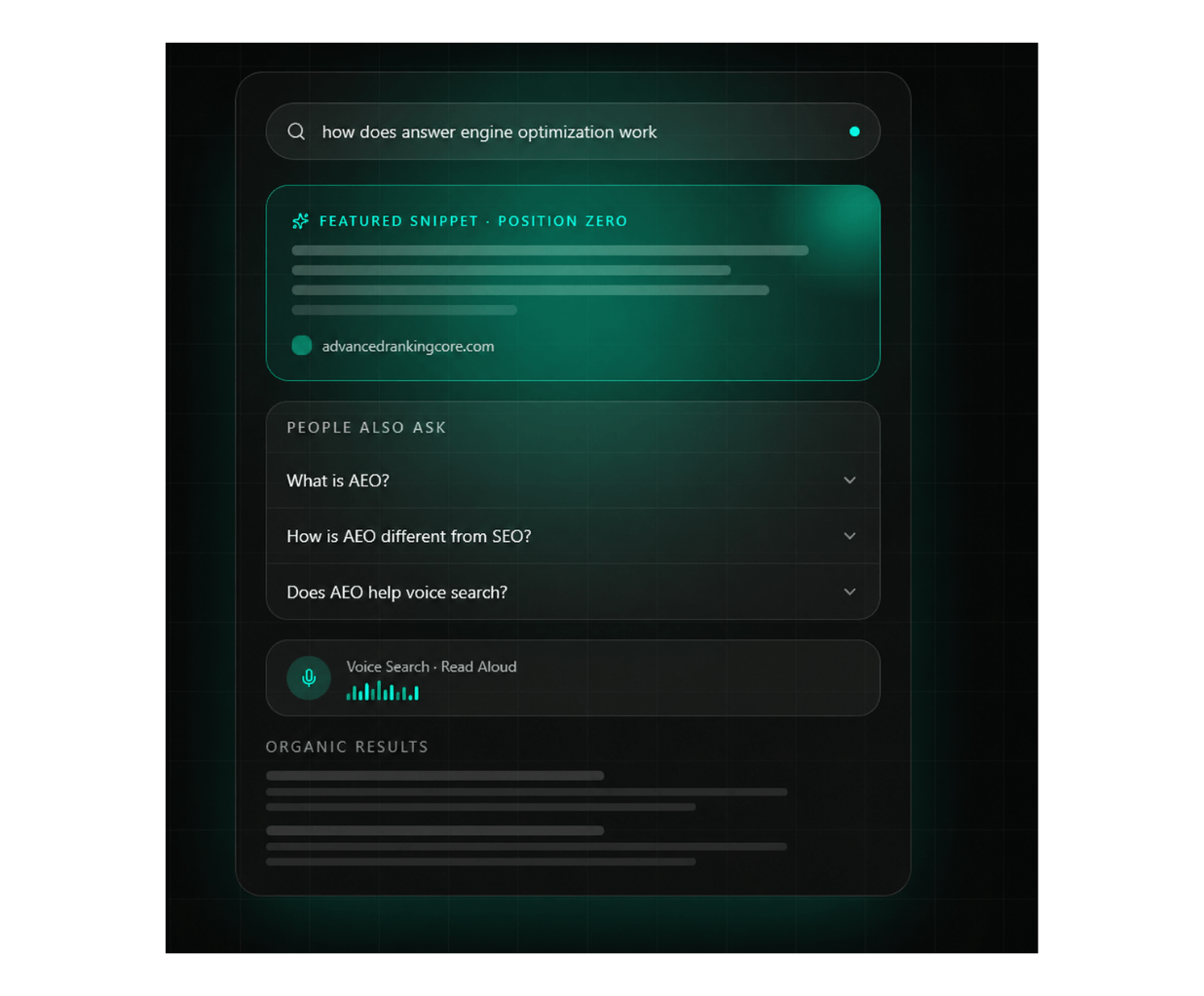
The targets are featured snippets, People Also Ask boxes, and voice-search responses — the surfaces where the engine answers the question itself rather than handing the user a list of links.
Where SEO competes for ten ranked positions on a page, AEO competes for one — the answer. Winning that one slot often produces more visibility, more clicks, and more brand recall than the #1 organic position underneath it.
What Is AEO?
Here’s The Two Sentence Definition:
AEO is the practice of structuring content so search engines lift a direct answer from it and surface that answer at the top of the Search Engine Results Page.
The targets are featured snippets, People Also Ask boxes, and voice-search responses — the surfaces where the engine answers the question itself rather than handing the user a list of links.
Where SEO competes for ten ranked positions on a page, AEO competes for one — the answer. Winning that one slot often produces more visibility, more clicks, and more brand recall than the #1 organic position underneath it.
The Three Surfaces
AEO Targets Three Answer Categories

Position Zero
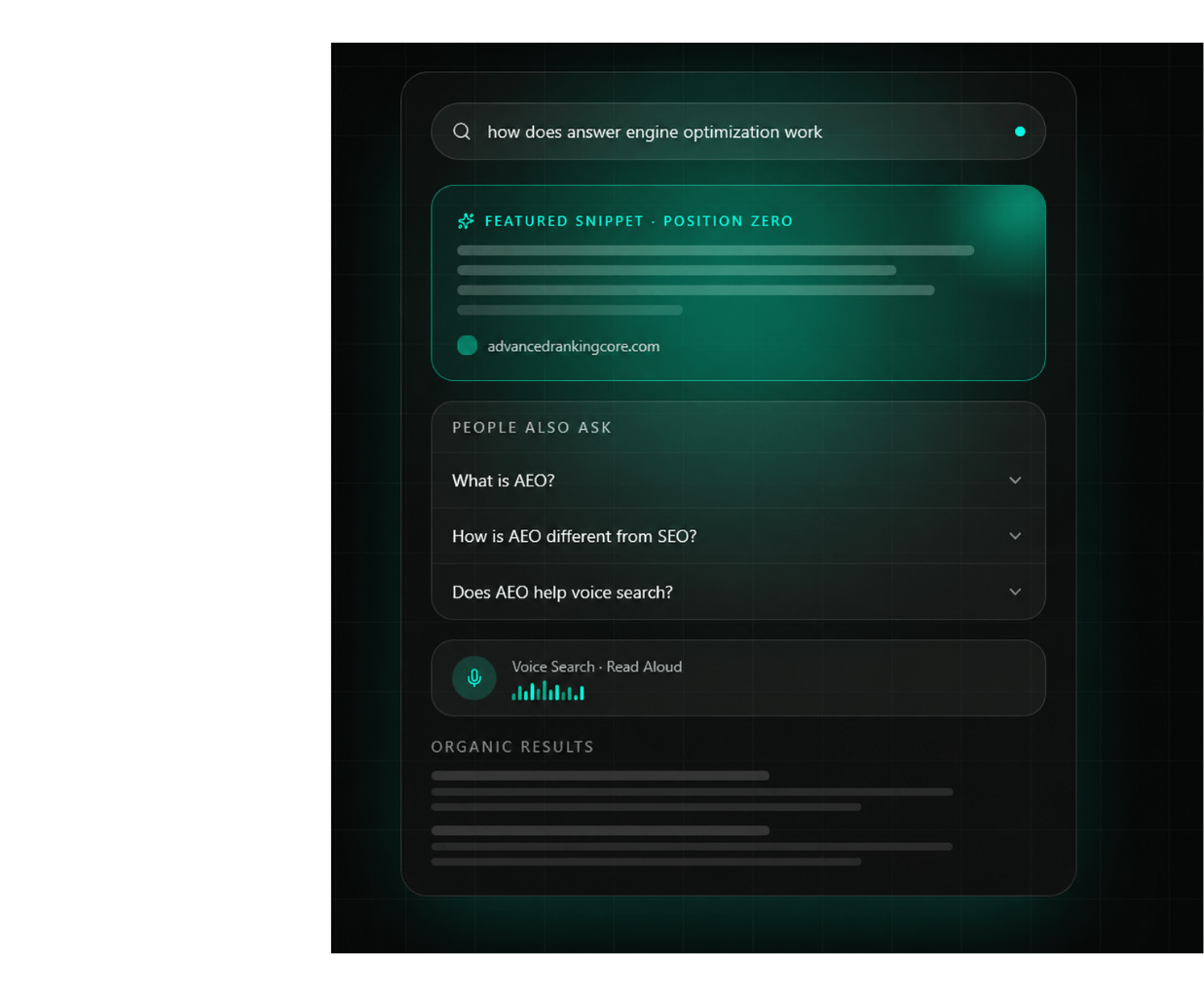
Position Zero is the boxed answer that Google sometimes places above the organic results. AEO pulls a paragraph, list, or table directly from a ranking page. This eliminates a prospect from scrolling further, often eliminates competing clicks, and takes credit for the answer.

Read Aloud by Assistants
Read Aloud by Assistants refers to Google Assistant, Siri, and Alexa. These resolve voice queries to a single spoken answer. That answer is usually pulled from the featured snippet — so winning AEO for the snippet wins voice search by default.

People Also Ask
“People Also Ask” Accordions are the expandable Q&A boxes that appear in the middle of search engine results pages. Each PAA expansion shows a short answer with a source link — and clicking one often spawns more PAA boxes, so a single PAA win surfaces your domain repeatedly.
The Shift
How AEO is Different From SEO
Dimension
Goal:
Real estate fought for
Content shape
Heading strategy
Schema
Voice-search benefit
Brand impact
Rank in 10 blue links
10 organic positions
Long-form, comprehensive
Keyword-rich
Helpful
Indirect
Click-dependent
AEO

Win the answer slot
1 — the featured snippet
Direct-answer-first, then detail
Question-shaped, exact-match user query
FAQ Page and How To required
Direct, same source surfaces both
Visible even without clicks
The Framework
Formula For AEO Success
AEO is more formulaic than SEO or GEO. The engines look for a specific shape, and you can deliver them deliberately:

Use the exact question as an H2 heading.
“How does Go High Level pricing work?” not “GHL pricing breakdown.”
Answer in 40–60 words immediately below.
One paragraph. Self-contained. No “as we discussed earlier” excess verbiage.
Follow with supporting details.
Lists, tables, or expanded paragraphs. The engine grabs the lead paragraph for the snippet, but the supporting structure earns the page authority.
Mark it up with FAQ Page schema.
This is the single highest-leverage AEO move. Google reads the schema, and People Also Ask placements and snippet selections weight schema-marked Q&A heavily.
Repeat the question in the answer.
“Go High Level pricing works on a tiered model…” rather than “It works on a tiered model…” Engines parse better with full antecedents.
Use clear formatting.
Numbered lists for “how-to” snippets. Definition lists for “what is” snippets. Tables for comparison snippets. Match the format the engine wants for that query type.
We get it
The Advanced Ranking Core® Solution
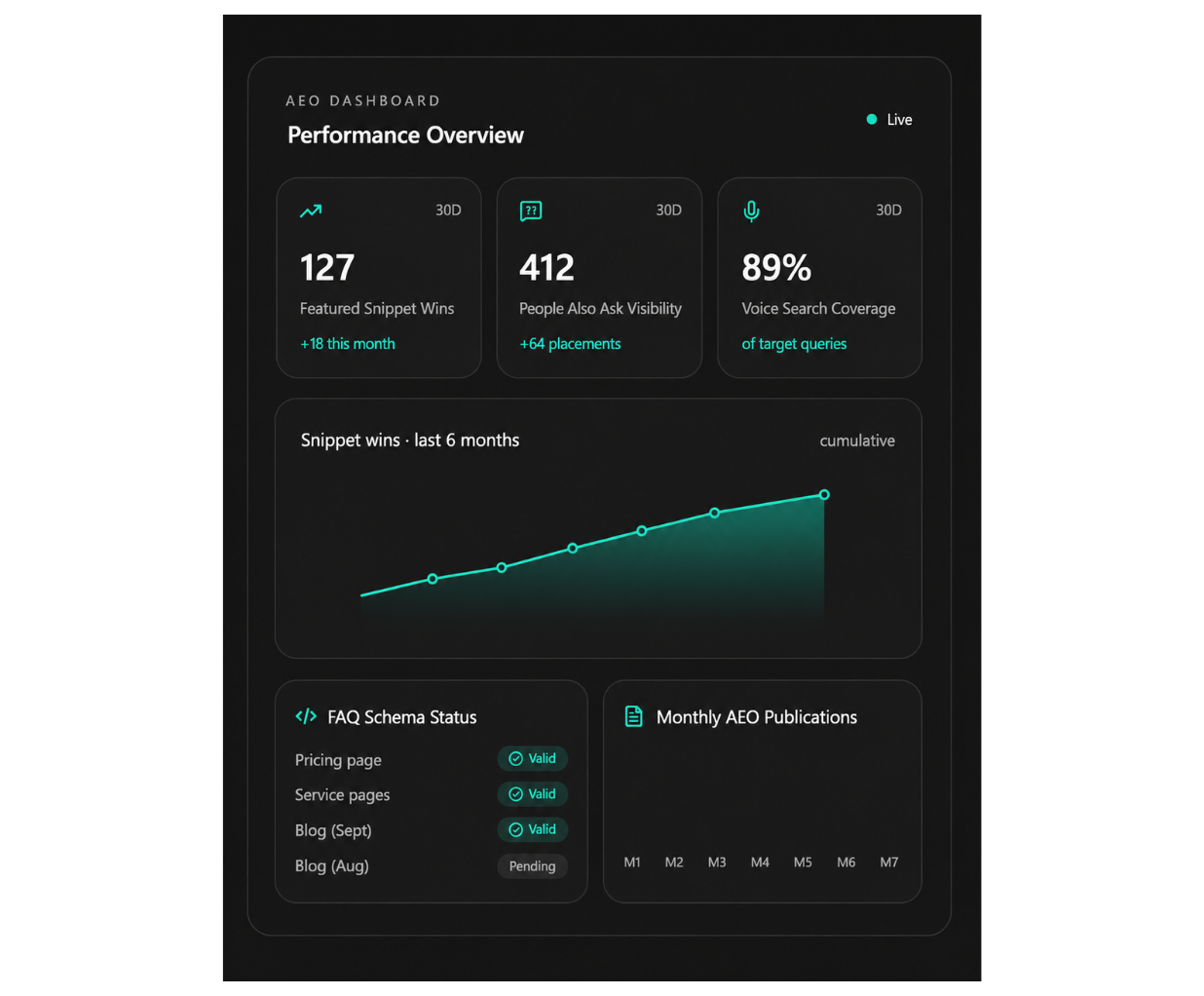
AEO discipline gets baked into every article published: question-shaped H2s, 40–60 word lead answers, FAQ Page and How To schema, structured supporting detail. We are not optimizing for snippets occasionally — we are optimizing for them on every piece, every month.
Combined with our GEO coverage for AI engines and our LSO coverage for local 3-pack and Maps, every angle of search visibility is in scope of one subscription.
Frequently Asked Questions About AEO

Is AEO different from GEO?
Yes. AEO targets answer surfaces inside traditional search engines — featured snippets, People Also Ask, voice. GEO targets citation inside generative AI engines like ChatGPT and Perplexity. The on-page tactics overlap heavily (direct-answer-first writing, schema, entity clarity) but the engines and surfacing mechanisms differ. Most modern strategies cover both.
Will winning a featured snippet hurt my click-through rate?
Sometimes. For purely informational queries (definitions, dates, simple facts), the snippet often resolves the user’s intent and the click does not happen. For commercial queries, the snippet is more often a brand-trust signal that drives a click anyway — and the brand visibility you gain typically outweighs any reduced clicks.
Does AEO still matter with AI Overviews?
Yes. AI Overviews replace some featured snippets but the optimization that wins snippets — direct-answer-first writing, FAQ Page schema, structured supporting detail — is exactly what AI Overviews reward. AEO-optimized content performs well across both surfaces.
Can a single page win multiple snippets?
Yes — and this is where schema becomes a force multiplier. A page with five well-formed Q&A pairs can win five separate PAA placements for related queries, each linking to the same source. One page, five visibility surfaces.