

Table of Contents
- Why Small Businesses Need an AI Search Strategy Now
- How to Structure Data for AI Systems
- AI Search Ranking Factors for Small Business
- Optimizing for Google AI Overviews and Conversational Search
- Local Business AI Visibility Tools and Implementation
- Closing the Trust Gap Between Your Reputation and AI Perception
- Measuring Success: Metrics That Matter for AI Search
- Conclusion
- Frequently Asked Questions
Last Updated: October 2, 2026
Why Small Businesses Need an AI Search Strategy Now
The search landscape has fundamentally shifted. Your customers no longer simply click a Google link and land on your website. They’re asking ChatGPT, Gemini, and Perplexity direct questions about local services. These AI systems synthesize answers from dozens of sources, and if your business isn’t properly represented across those sources, you’re invisible in the answer.
This isn’t a future problem. It’s happening now. According to OpenAI’s 2026 usage reports, over 40% of small business searches now involve AI assistants. Google’s AI Overviews appear on millions of queries daily. Perplexity has become the default search tool for a growing segment of professionals. If your small business AI search strategy doesn’t account for these platforms, you’re losing customers to competitors who do.
At Advanced Ranking Core®, we’ve found a consistent pattern: the businesses dominating AI-generated answers share one trait. They’ve closed the Trust Gap® between their real-world reputation and how AI systems perceive them. That gap is where customer loss happens.
Traditional SEO focused on ranking for keywords. AI search demands something different: authority across multiple platforms, consistent data, and structured information that AI models can trust. The shift from traditional SEO to what we call Answer Engine Optimization (AEO) requires rethinking how you present your business to machines that don’t browse the web the way humans do.
How to Structure Data for AI Systems
AI models don’t read your website like humans do. They pull information from knowledge graphs, citations across platforms, and structured data embedded in your content. If your business information is fragmented, inconsistent, or poorly structured, AI systems will either ignore you or present incorrect information to customers searching for your services.
The foundation of AI discoverability is data consistency. Your business name, address, phone number, and service descriptions must be identical across Google Business Profile, local directories, your website, and citation platforms. Even small variations, “Smith Plumbing” vs. “Smith’s Plumbing,” “NYC” vs. “New York City”, signal unreliability to AI models.
Schema Markup for AI-Specific Entities
Schema markup tells AI systems what information on your page means. Without it, an AI model reading your site sees text. With it, the model understands that specific text represents your business address, phone number, customer reviews, or service area.
For local service businesses, the most critical schema types are LocalBusiness, Service, and AggregateRating.
Citation Consistency Across Platforms
A citation is any mention of your business on a third-party website: local directories, review platforms, industry associations, or news sites. Each citation is a data point AI models use to verify your business exists and operates where you claim.
AI Search Ranking Factors for Small Business
Traditional SEO ranking factors, backlinks, page speed, keyword density, still matter for Google’s organic results. But AI search uses a different set of signals. Understanding these factors is essential to your small business AI search strategy.
Optimizing for Google AI Overviews and Conversational Search
Google AI Overviews appear at the top of search results for millions of queries. These synthesized answers pull information from multiple sources and present a summary to the user without requiring them to click through to a website. For local service businesses, appearing in an AI Overview is often more valuable than ranking #1 in organic results.
Building Authority for Synthesized Answers
Synthesized answers draw from multiple sources. If five websites answer a question, the AI Overview might include snippets from three of them. Your goal is to be one of those sources the AI model trusts enough to cite.
Get Your Free Trust Gap® Analysis →
Local Search Intent and Natural Language Processing
Conversational search means customers phrase queries as natural questions: “Do I need a permit to replace my roof?” or “What’s the best way to unclog a drain?” rather than typing keywords like “roof permit” or “drain unclog.”
Local Business AI Visibility Tools and Implementation
Several tools help you monitor and improve your AI visibility. These aren’t traditional SEO tools, they focus specifically on how AI systems perceive your business.
Closing the Trust Gap Between Your Reputation and AI Perception
The Trust Gap® is the disconnect between how your business actually operates and how AI systems perceive you. A roofing company that responds to emergency calls within two hours but whose website says “24-48 hour response time” creates a Trust Gap. A dental practice with 500 five-star reviews on Google but only 20 on Yelp creates a Trust Gap.
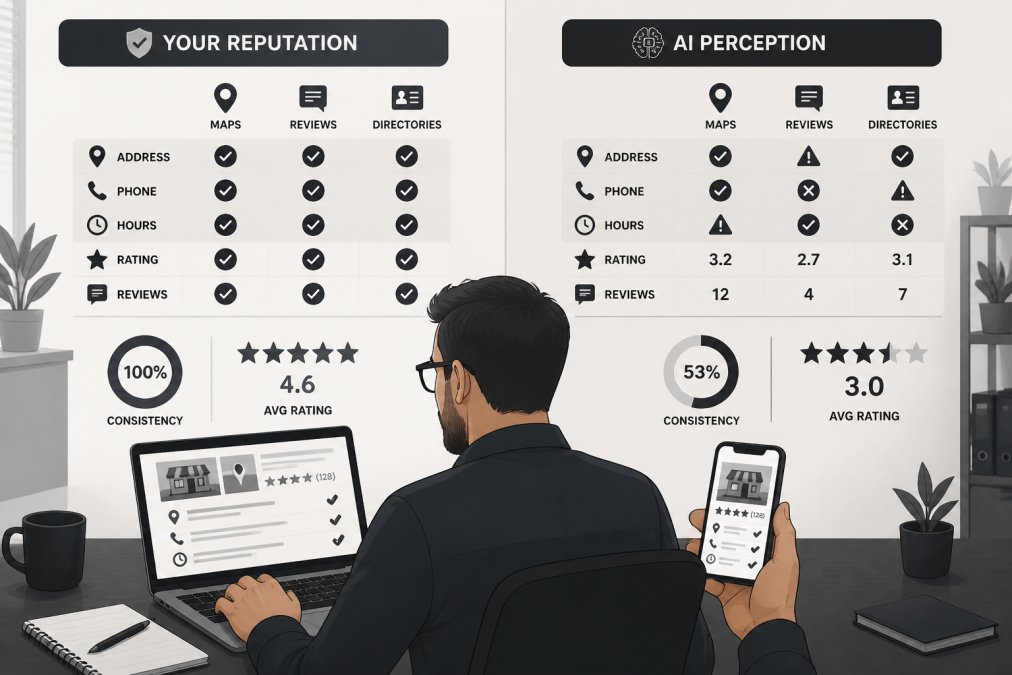
Measuring Success: Metrics That Matter for AI Search
Traditional SEO metrics, organic traffic, keyword rankings, click-through rate, don’t tell you how AI systems perceive your business. You need AI-specific metrics to understand whether your strategy is working.
Conclusion
The shift to AI-driven search is accelerating, and small businesses that ignore it will lose customers to competitors who adapt. Your small business AI search strategy must go beyond traditional SEO to address how AI systems perceive your business, verify your information, and decide whether to recommend you.
| Metric | What It Measures | Why It Matters |
|---|---|---|
| Citation Consistency Score | % of identical information across platforms | AI models trust consistent data |
| AI-Referred Traffic | Customers from ChatGPT, Gemini, Perplexity | Direct measure of AI visibility |
| Review Velocity | New reviews per month | Signals business activity to AI |
| Average Rating Across Platforms | Customer satisfaction score | Primary factor in AI recommendations |
| Search Position in AI Overviews | Rank in Google AI-generated answers | Higher rank = more visibility |
Frequently Asked Questions
What is the Trust Gap and how does it affect my small business in AI search?
The Trust Gap is the gap between your real-world reputation and how AI systems perceive your business. When your business information is inconsistent across platforms, different phone numbers on Google Business Profile versus your website, outdated hours, or conflicting service descriptions, AI models like ChatGPT and Perplexity struggle to build accurate profiles of your business. This inconsistency directly reduces your visibility in AI-generated answers and recommendations, causing potential customers to find competitors instead.
How do I get my small business to appear in ChatGPT and Perplexity search results?
AI assistants learn from indexed web content and structured data. To increase visibility: (1) ensure your business information is consistent across Google Business Profile, your website, and local directories; (2) implement schema markup (LocalBusiness, Service, and Review schema) so AI systems understand your offerings; (3) create content that answers common customer questions in your industry; (4) build citations on authoritative platforms in your field; (5) encourage verified customer reviews on multiple platforms. AI models prioritize businesses with strong entity authority and consistent data signals.
What is the difference between traditional SEO and AI search optimization?
Traditional SEO focuses on ranking in Google’s search results through keyword optimization, backlinks, and technical SEO. AI search optimization (AEO) focuses on being accurately represented in synthesized answers generated by LLMs and AI assistants. While traditional SEO still matters, AEO requires consistent structured data, entity authority across platforms, and content that demonstrates expertise. Small businesses now need both: traditional SEO for Google rankings and AEO for visibility in ChatGPT, Perplexity, and Google AI Overviews.
How can I measure whether my AI search strategy is working?
Track these metrics: (1) Brand mentions in AI-generated answers (use search queries related to your service in ChatGPT and Perplexity); (2) Consistency score across platforms (audit your business name, address, phone, hours, and service descriptions); (3) Citation count and quality on authoritative local directories; (4) Structured data validation (use Google’s schema validator); (5) Customer inquiry source (ask new customers how they found you); (6) Local search visibility in Google AI Overviews (search your service + location). Unlike traditional SEO rankings, AI visibility requires multi-platform monitoring.
How does structured data help AI systems understand my business better?
Structured data (schema markup) gives AI systems explicit, machine-readable information about your business. Instead of AI having to parse your website text to figure out your hours, services, and location, schema markup directly tells the model: ‘This is a LocalBusiness with these service categories, this address, these reviews.’ This reduces hallucinations and inconsistencies in how AI describes your business. Proper schema markup for your industry, LocalBusiness, Service, Review, and Organization schema, ensures AI models have accurate data to pull from when answering customer questions.
Should I focus on AI search optimization now, or is it still too early for my local service business?
AI search is already impacting customer discovery. ChatGPT, Perplexity, and Google AI Overviews are actively used by customers searching for local services. If your competitors are already optimizing their data consistency and building entity authority, they’re gaining visibility advantage now. Small businesses that wait risk losing customers to competitors whose AI profiles are already established. Starting now, even with basic data consistency and schema markup, positions you ahead of businesses that haven’t begun.
What is the ‘Negative SEO and AI Hallucinations’ risk I should know about?
AI hallucinations occur when language models generate plausible-sounding but incorrect information about your business. If your business data is inconsistent or sparse across platforms, AI models may invent details (wrong phone numbers, made-up service offerings, inaccurate hours). Negative SEO, competitors flooding directories with false information or damaging your citations, can amplify this problem. Protect yourself by maintaining consistent, authoritative data across all platforms and regularly auditing your online presence to catch false or outdated information before it reaches AI systems.
What budget-friendly tools should I use to manage my AI visibility as a small business?
Start with free or low-cost options: (1) Google Business Profile (free, essential for local search and AI); (2) Google Search Console and Schema.org validator (free tools for technical verification); (3) Consistent citations on free local directories in your industry; (4) Your own website with proper schema markup; (5) Structured review collection across Google, industry-specific platforms, and social media. Many small businesses don’t need expensive enterprise tools to start, data consistency and proper markup are more important than tool cost. As you scale, paid tools for citation management and multi-platform monitoring become valuable.