

Table of Contents
- Why Tracking AI Rankings Matters for Your Business
- Quick Comparison Table: AI Ranking Tracking Tools
- Advanced Ranking Core: Multi-Channel AI Visibility Strategy
- LLM Tracking Tools: Monitoring ChatGPT, Perplexity, and Gemini
- AI Overview Rank Tracking Tools for Google Search
- AI Search Visibility for Small Businesses: Local Service Companies
- Local SEO Rank Tracking Tools: Bridging Traditional and AI Search
- How to Choose the Right AI Ranking Tracking Tool
- 1. Ask how the tool samples prompts (and how often)
- 2. Check geographic and language coverage against your actual market
- 3. Define your KPIs before you compare tools
- 4. Establish a baseline before you change anything
- 5. Interpret changes with a volatility discount
- 6. Turn findings into actions, not dashboards
- 7. Check data ownership and integrations before you commit
- 8. Match tool tier to team, not to budget alone
- Frequently Asked Questions
Last Updated: October 18, 2026
Why Tracking AI Rankings Matters for Your Business
Your competitors aren’t just fighting for Google’s top 10 anymore. They’re competing for visibility in ChatGPT, Perplexity, and Google’s AI Overviews, where customers increasingly get their answers.
Customers now ask AI assistants questions instead of typing them into search bars.
The challenge isn’t just appearing in AI search results. It’s ensuring your business information is consistent, authoritative, and discoverable across multiple AI platforms simultaneously, something traditional SEO tools, built for Google rankings, miss entirely.
AI search visibility requires active monitoring across multiple platforms, not just Google. Without it, you’re flying blind while your market shifts.
Quick Comparison Table: AI Ranking Tracking Tools
Most ‘best AI ranking tools’ lists stop at a feature grid, hiding the two things that determine whether a tool works for you: which AI engines it samples, and what a realistic monthly bill looks like once you add prompts and seats.
| Tool | Best For | AI Engines Tracked | Entry Pricing Model | Key Strength | Common Limitation |
|---|---|---|---|---|---|
| Advanced Ranking Core® | Local service businesses | Google AI Overviews, ChatGPT, Perplexity | Custom (quote-based) | Trust Gap analysis + 47-rule AI writing framework | Not a self-serve SaaS; requires onboarding |
| Rankscale | Teams tracking ChatGPT & Perplexity | ChatGPT, Perplexity, Gemini, Copilot, Google AI Overviews | Credit-based; prompts bundled, no per-engine upsell | Transparent credit model; multi-engine without add-on fees | Credit burn is fast if you track long-tail prompt sets |
| Nightwatch | SEO teams adding AI monitoring | Google AI Overviews, ChatGPT, Perplexity (plus traditional SERP) | Per-tracked-keyword subscription | Bridges classic rank tracking and AI Overview citations in one dashboard | AI Overview data is newer than its SERP data; expect occasional gaps |
| ZipTie | Deep analysis and reporting | Google AI Overviews, ChatGPT, Perplexity, Gemini | Tiered subscription by project | Reporting depth and local/AI blended dashboards | Steeper learning curve; overkill for single-location businesses |
| Otterly.AI | Budget-conscious teams | ChatGPT, Perplexity, Google AI Overviews, Gemini | Low-cost entry tier | Fast setup; good ‘is this real for my market?’ test | Limited competitive context and historical depth on entry plan |
| Profound | Enterprise brand monitoring | ChatGPT, Perplexity, Gemini, Copilot, Google AI Overviews | Enterprise contract | Prompt-volume sampling at scale; strong reporting exports | Pricing and onboarding are enterprise-oriented |
| Peec AI | Agencies managing multiple brands | ChatGPT, Perplexity, Google AI Overviews, Gemini | Per-brand subscription | Multi-brand workspaces and share-of-voice views | Smaller engine list than enterprise rivals |
| Scrunch AI | Content teams acting on AI visibility | ChatGPT, Perplexity, Gemini, Google AI Overviews | Tiered by prompt volume | Ties AI visibility findings to content recommendations | Newer platform; integrations still maturing |
| Semrush (AI Toolkit) | Teams already in Semrush | Google AI Overviews, ChatGPT, Perplexity | Add-on to existing Semrush plan | Familiar interface; bundles with traditional SEO data | AI features are an add-on, not the core product |
| Ahrefs (Brand Radar) | Teams already in Ahrefs | ChatGPT, Perplexity, Google AI Overviews, Gemini | Add-on to existing Ahrefs plan | Large prompt index; strong brand-mention data | AI visibility is one module inside a broader SEO suite |
Two caveats before shortlisting. Engine coverage changes quarterly, confirm it on the vendor’s changelog, not a review site.
Before comparing prices, write down your prompt list first. A tool that looks cheap at 25 prompts can cost more than a ‘premium’ rival once you’re tracking 150 prompts across four engines.
Advanced Ranking Core: Multi-Channel AI Visibility Strategy
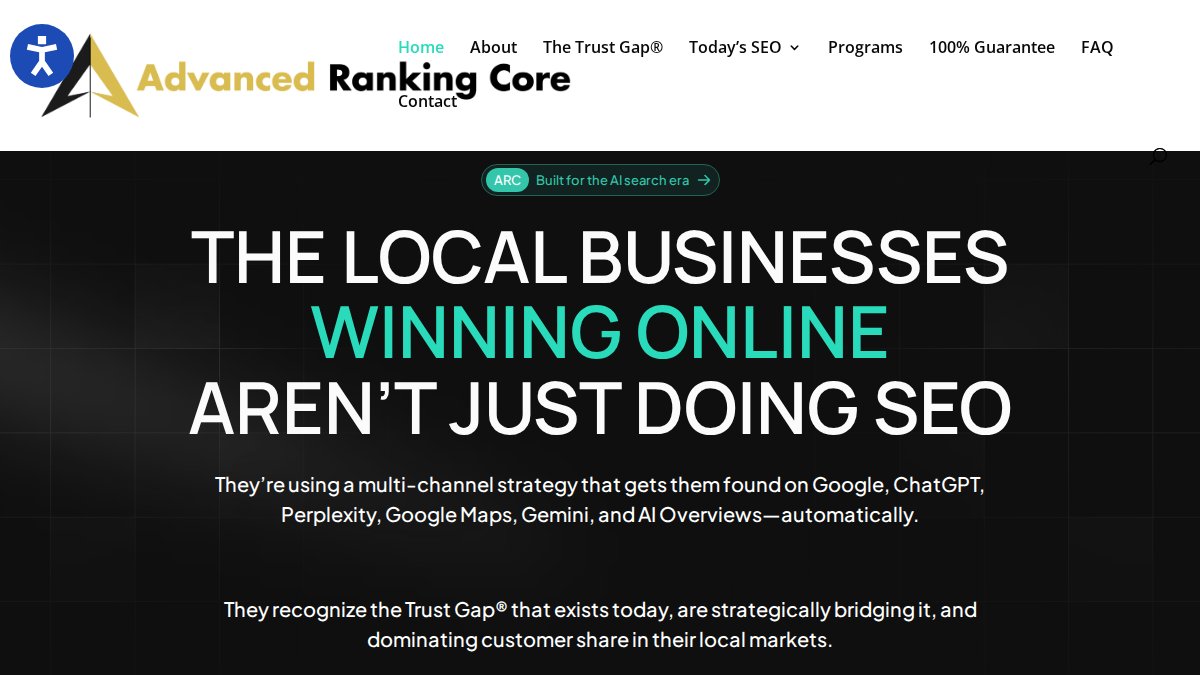
Advanced Ranking Core® isn’t a traditional rank tracker. It’s built specifically for the problem most local service businesses face: their real reputation doesn’t match how AI systems perceive them.
The platform analyzes your presence across Google, ChatGPT, Perplexity, and AI Overviews simultaneously.
What sets it apart is the Trust Gap analysis: a clear picture of where your business information is inconsistent or missing across platforms.
The real ROI comes from preventing invisible customer loss. Most businesses don’t know how many potential customers asked an AI for a recommendation and got a competitor’s name instead.
LLM Tracking Tools: Monitoring ChatGPT, Perplexity, and Gemini
Tracking visibility in ChatGPT and Perplexity requires a different approach than traditional rank tracking.
Rankscale monitors how often your business appears in ChatGPT and Perplexity responses to relevant queries.
For local service businesses, this matters enormously. A dentist in Portland wants to know: when someone asks ChatGPT “best dental implant specialists near me,” does my practice show up?
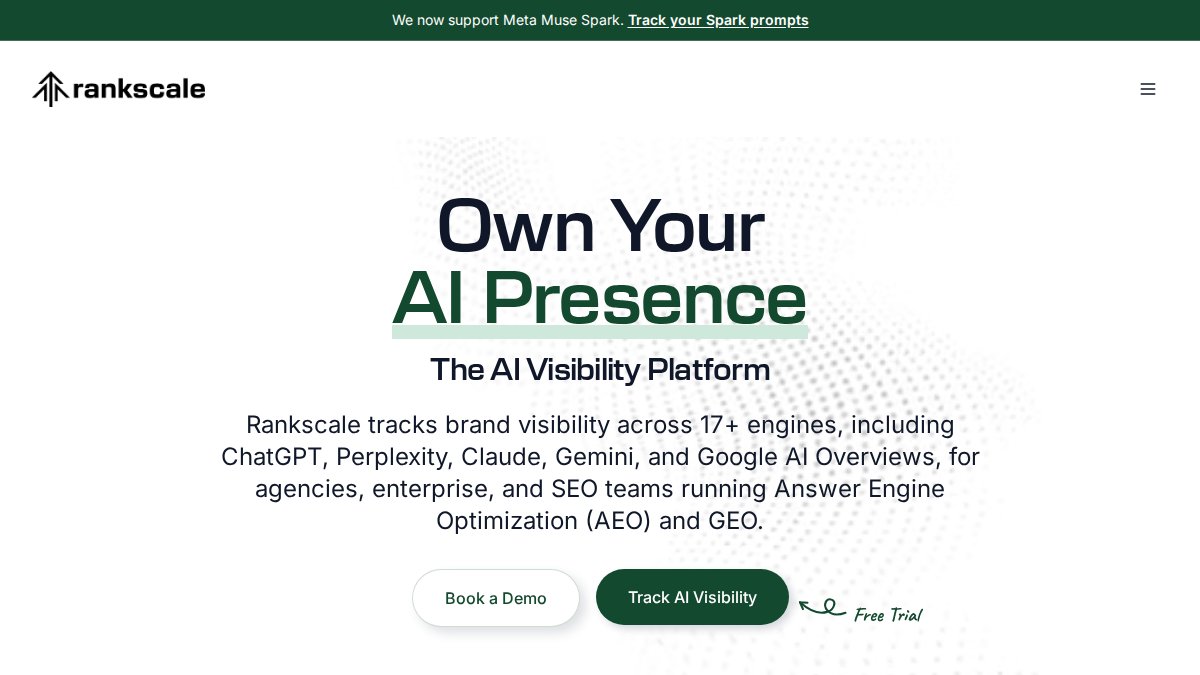
Perplexity tracking is particularly valuable because Perplexity explicitly cites sources.
AI Overview Rank Tracking Tools for Google Search
Google’s AI Overviews have changed how people interact with search results.
Nightwatch bridges traditional SEO and AI visibility by showing conventional rankings alongside AI Overview appearances.
The platform tracks which pages get cited in AI Overviews and in what context.
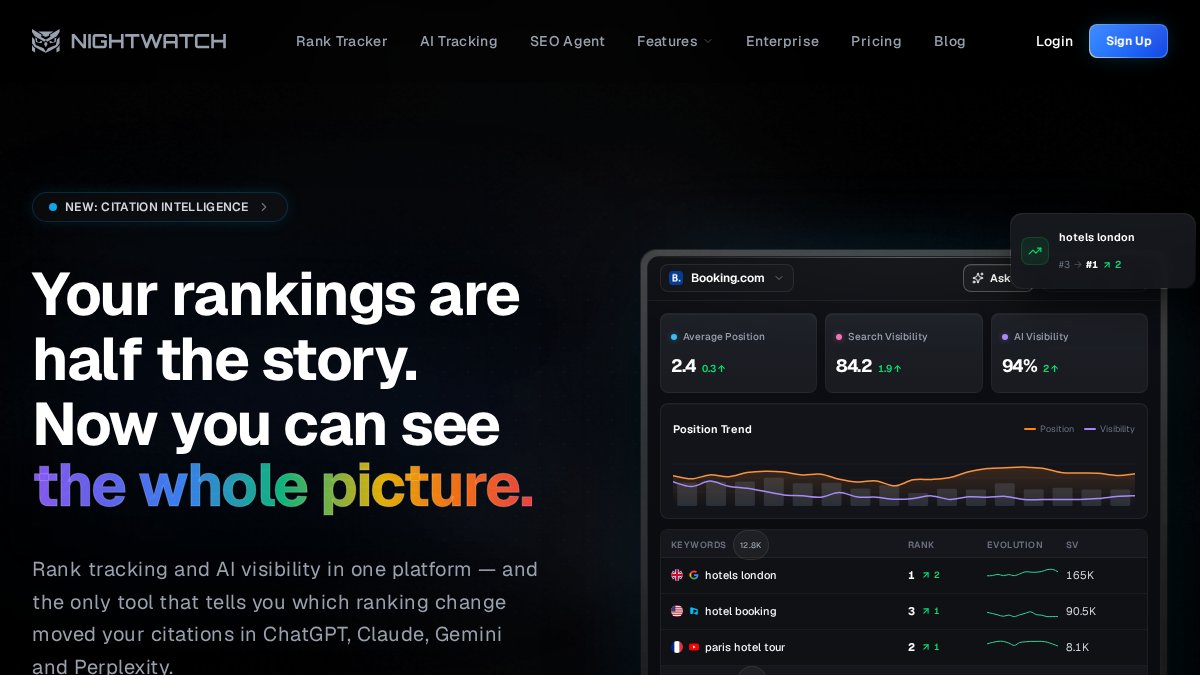
AI Overview visibility requires different metrics than traditional rankings: citation frequency, context relevance, and traffic quality, not just position. Nightwatch translates this into actionable reporting.
AI Search Visibility for Small Businesses: Local Service Companies
For a small plumbing company with a limited marketing budget, AI search visibility might feel like a luxury.
When a homeowner asks ChatGPT “who should I call for emergency plumbing,” the AI pulls from available information about local plumbers.
Otterly.AI addresses this at an entry-level price point, monitoring AI search visibility without enterprise complexity.
The limitation is depth: Otterly.AI gives headline data, mentioned or not, with less context on quality, positioning, or competitors.
Local SEO Rank Tracking Tools: Bridging Traditional and AI Search
Local SEO and AI search visibility are converging. Google Maps rankings, local pack visibility, and AI Overview appearances all hinge on the same factors: business data consistency, review quality, and local relevance signals.
ZipTie tracks traditional local rankings while monitoring AI search visibility, showing Google Maps position, local pack appearances, and AI Overview citations in one dashboard.
For a dental practice, this integrated view prevents the trap of optimizing for Google Maps while ignoring AI search. Both matter. ZipTie keeps you accountable to both.
How to Choose the Right AI Ranking Tracking Tool
Most buying guides tell you to ‘pick the tool that fits your needs’, a shrug, not a framework. The harder question: are the numbers these tools show you trustworthy enough to act on?

1. Ask how the tool samples prompts (and how often)
Every AI visibility tool sends prompts to AI engines and records whether your brand appears. What matters: how many prompts, how often they’re re-run, and whether runs are repeated to smooth variance. A tool sampling 20 prompts weekly shows a noisier picture than one sampling 200 daily with three repeats each. Ask each vendor: *How many prompts per tracked topic?
2. Check geographic and language coverage against your actual market
A national B2B brand and a single-location plumber need very different geographic sampling. AI engines personalize answers by location, so a tool sampling from one data center will systematically miss local visibility. Ask: Which countries and languages do you sample from? Can I set sampling location per prompt? For local businesses, this is the most important question, a tool that can’t sample from your metro will under-report your visibility.
3. Define your KPIs before you compare tools
‘AI visibility’ is not one metric. It’s at least five, and each has a different limitation:
- Answer presence, did your brand appear in the AI answer at all? Simple, but binary and easy to game with a single mention.
- Citation share, of the sources the AI cited, what percentage were yours? Strong for content teams, but only works on engines that cite sources (Perplexity, Google AI Overviews) and not on engines that synthesize without attribution (much of ChatGPT).
- Share of voice vs. competitors, your mentions as a percentage of all brand mentions in the answer set. Useful for competitive tracking, but sensitive to which competitors you include in the prompt set.
Pick two or three of these as your primary KPIs and make sure the tool you choose reports them natively. A tool that only reports ‘visibility score’ forces you to reverse-engineer what’s inside it.
4. Establish a baseline before you change anything
A common mistake is to sign up, see a low score, and immediately rewrite content, making it impossible to know whether later changes helped. Instead, run the tool for 2-4 weeks without changing anything and record the baseline: which prompts you appear in, which competitors appear, which sources are cited. AI answers are volatile enough that you need a baseline window, not a snapshot, before attributing change to your work.
5. Interpret changes with a volatility discount
AI answers fluctuate for reasons unrelated to your work: model updates, retrieval index refreshes, prompt phrasing. A 10% week-over-week swing is usually noise; a sustained 30%+ shift over 4-6 weeks, corroborated across prompts, is a signal. Review monthly, not daily, and note model-update dates so you don’t misattribute a vendor’s model change to your content strategy.
6. Turn findings into actions, not dashboards
The output of tracking should be a short list of actions, not a prettier chart. A practical workflow:
- Identify prompts where competitors appear and you don’t. These are your content gaps.
- Check which sources the AI cited for those prompts. If a competitor’s page or a third-party directory is being cited, that’s the page to improve or the listing to fix.
- Fix data consistency first. For local businesses, inconsistent NAP data across directories is the most common cause of missing from AI answers, cheaper to fix than new content.
- Publish or update content against the cited sources. Match the structure, specificity, and freshness of the pages the AI is already trusting.
- Re-measure after 4-6 weeks. Compare against your baseline, not against last week.
7. Check data ownership and integrations before you commit
Ask each vendor: Can I export raw prompt-level data, or only summary dashboards? Is there an API? How long do you retain history? Teams blending AI visibility with SEO, analytics, or BI need raw exports and API access; weekly-report teams don’t. Also confirm in writing whether the vendor uses your prompt data to train or benchmark its models.
No AI visibility tool measures the full picture. Each one samples a subset of prompts, from a subset of locations, on a subset of engines. Treat any single score as one input among several, and cross-check major changes against your own manual spot-checks in ChatGPT, Perplexity, and Google before you rebuild a content strategy around them.
8. Match tool tier to team, not to budget alone
A solo operator or single-location business rarely needs enterprise prompt volumes; a mid-tier plan with 50-100 tracked prompts across three engines usually shows whether AI visibility is a real channel in their market. Agencies managing multiple brands should prioritize multi-workspace support and share-of-voice reporting over raw prompt volume. Enterprise brands should prioritize sampling frequency, API access, and historical retention, hardest to add later.
Frequently Asked Questions
What is the difference between AI rank tracking and traditional SEO rank tracking?
Traditional SEO rank tracking monitors where your website appears in Google’s search results for specific keywords. AI rank tracking monitors whether your business is mentioned, recommended, or cited in AI-generated answers from ChatGPT, Perplexity, Google AI Overviews, and similar large language models. A business can rank well in Google but be invisible to AI systems, or vice versa. This gap, often called the ‘Trust Gap’, means you need both types of tracking to understand your full online visibility.
Which LLM tracking tools are best for monitoring ChatGPT and Perplexity visibility?
Rankscale, Nightwatch, and Advanced Ranking Core all track visibility across ChatGPT and Perplexity. Rankscale uses a credit-based subscription model and explicitly supports both platforms without per-engine upsells. Nightwatch combines AI visibility monitoring with traditional SEO context. Advanced Ranking Core offers a multi-channel strategy specifically designed to ensure your business is accurately represented across these AI platforms, with strategic oversight from experienced professionals.
How accurate are AI search ranking tools at measuring visibility?
Accuracy depends on how each tool measures visibility. Some tools track brand mentions and citations in AI responses, while others monitor whether your business appears in answer summaries. The most reliable tools use transparent testing methodologies and clearly define their measurement approach. Before choosing a tool, verify what metrics it actually reports, whether it’s counting mentions, tracking source attribution, measuring answer frequency, or monitoring sentiment. Tools that explain their limitations and testing methods tend to be more trustworthy than those making broad accuracy claims.
Are there free tools for tracking AI search visibility?
Advanced Ranking Core offers a free tier that includes Trust Gap analysis, allowing you to see how inconsistencies in your business information across platforms affect your AI visibility. Most specialized AI ranking tracking tools (Rankscale, Nightwatch, Otterly.AI, ZipTie, Peec AI) do not offer free plans, though some may have trial periods. If you’re starting out, a free Trust Gap analysis can reveal whether AI visibility is a priority for your business before you invest in paid tracking tools.