

Last Updated: October 26, 2026
Quick Summary
An AccuRanker alternative AI tracking solution monitors whether AI systems like ChatGPT, Perplexity, and Gemini recommend your business, measuring brand mentions, citation frequency, and accuracy across multiple AI surfaces. Leading alternatives include Advanced Ranking Core®, Nightwatch, TrueRanker, Search Atlas, and Serpify, each offering different strengths in local SERP tracking and AI visibility monitoring.
- Advanced Ranking Core® analyzes the Trust Gap® between real-world reputation and AI system perception for local service businesses.
- Nightwatch combines 107,000+ local tracking locations with LLM visibility monitoring in one dashboard.
- Evaluate tools on six criteria: AI answer coverage, tracked platforms, citation tracking, brand mention detection, reporting exports, and traditional rank tracking.
- Local businesses should audit information consistency across Google Business Profile, websites, directories, and review sites before implementing AI tracking.
- Citation frequency often moves before mention frequency, making it a leading indicator of future AI recommendations.
Table of Contents
- Why AccuRanker Alternatives Matter for AI Search Visibility
- Comparison Table: AccuRanker Alternatives for AI Tracking
- AI Search Visibility Tracking Tools: Feature Breakdown
- ChatGPT Brand Monitoring Tools and LLM Visibility
- Google AI Overviews Tracking: What You Need to Monitor
- AI Search Tracking Best Practices for Local Businesses
- Choosing Your AI Tracking Solution: Next Steps
- Frequently Asked Questions
Why AccuRanker Alternatives Matter for AI Search Visibility
Your customers aren’t just typing queries into Google anymore, they’re asking ChatGPT, Perplexity, and Gemini what to buy, where to go, and who to trust. That makes AccuRanker alternative AI tracking solutions essential.
Advanced Ranking Core® helps local businesses navigate the AI-driven search landscape by bridging the ‘Trust Gap®’ between their real-world reputation and how AI systems perceive them.
The tools you choose determine what you can measure. Some platforms focus entirely on traditional SERP monitoring, others bolted on AI visibility as an afterthought, and a few were built to track both.
Comparison Table: AccuRanker Alternatives for AI Tracking
| Tool | Best For | Key Strength | AI Tracking | Local SERP Tracking |
|---|---|---|---|---|
| Advanced Ranking Core® | Local service businesses | Trust Gap® analysis + multi-channel AI strategy | Yes | Yes |
| Nightwatch | Teams needing location precision | 107,000+ local tracking locations | Yes | Yes |
| TrueRanker | Hybrid traditional + AI tracking | Native AI visibility features | Yes | Yes |
| Search Atlas | All-in-one SEO + LLM visibility | Real-time data across platforms | Yes | Limited |
| Serpify | API-first users | Keyword research + AI tracking + integrations | Yes | Yes |
AI Search Visibility Tracking Tools: Feature Breakdown
Most AccuRanker alternative lists describe each tool in isolation, which makes it hard to answer the real question: which platform tracks AI visibility in a way you can act on? Below is our criteria-based framework, followed by how the leading options map to it.
The six criteria that separate real AI tracking from marketing claims
Evaluate every tool against the same six dimensions; a platform that scores well on one but ignores the rest will leave blind spots.
- AI answer coverage, Which AI surfaces does the tool monitor? At minimum you want ChatGPT, Google AI Overviews, Perplexity, and Gemini. Ask whether coverage is live querying, cached snapshots, or periodic sampling, and how often each surface refreshes.
- Tracked platforms and prompt limits, How many prompts can you monitor per plan, and are prompts counted per market, per brand, or per language? A tool that caps prompts at 50 will not cover a multi-location service business.
- Citation tracking, Does the tool show which URLs the AI cited, not just whether your brand was mentioned? Citation frequency is often the leading indicator of future mentions.
- Brand mention detection, Can it distinguish a direct recommendation from a passing reference, and does it flag inaccurate descriptions of your business?
- Reporting and exports, Look for share-of-voice views, competitor overlays, scheduled reports, and API or CSV export. If you cannot get the data out, you cannot act on it.
- Traditional rank tracking alongside AI, Many teams still need Google position data. Check whether AI tracking is native to the same dashboard or a bolted-on module with separate billing.
How the leading options map to those criteria
Advanced Ranking Core® was built around the Trust Gap®, the difference between how your business operates and how AI systems describe it.
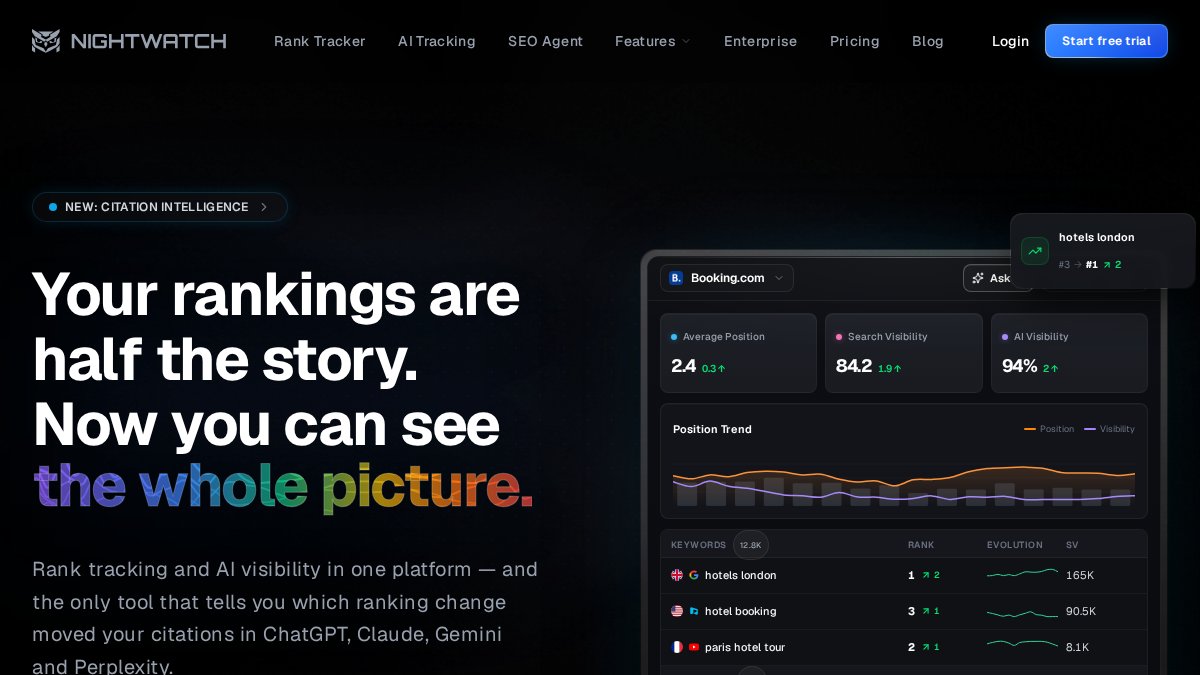
Nightwatch is strongest on location precision, combining a very large set of local locations with LLM visibility monitoring.
TrueRanker treats AI visibility as native rather than an add-on, a reasonable single-platform option for teams wanting both tracking types.
Search Atlas emphasizes real-time data and all-in-one SEO plus LLM visibility.
Serpify is API-first, useful for piping ranking and AI visibility data into your own dashboards or client reporting.
Before you trial any tool, write down your prompt list, your markets, and your refresh expectations. Then ask each vendor to show those exact prompts in a live demo. A tool that cannot demonstrate your real queries is not tracking your visibility, it is tracking a demo.
For a deeper comparison of AI-specific tracking capabilities, see our guide to best tools for tracking AI rankings in 2026, and for implementation details read how to track visibility in AI search.
ChatGPT Brand Monitoring Tools and LLM Visibility
ChatGPT mentions businesses two ways: directly in responses and through citations in referenced sources. Traditional SEO tools measure neither, so ChatGPT brand monitoring requires a different measurement model. Most AccuRanker alternative articles never define the metrics, without shared definitions, you cannot compare tools on equivalent terms.
The metrics that make AI visibility comparable
Use these definitions when you evaluate any AI tracking platform. Ask each vendor how they calculate each one.
- Brand mentions, The count of responses in which your brand is named, split by direct recommendation versus passing reference. Ask whether mentions are deduplicated across prompts and sessions.
- Citation frequency, How often your URLs appear in the sources an AI cites, independent of whether your brand is named. Citation frequency often moves before mention frequency does.
- Share of voice, Your mentions divided by total brand mentions across a defined prompt set, expressed as a percentage. This is the metric that makes competitor comparison meaningful.
- Prompt coverage, The share of your target prompt list in which you appear at all. A tool tracking 20 prompts tells a very different story than one tracking 200.
- Sentiment and accuracy, Whether the AI describes your business positively, neutrally, or negatively, and whether the facts it states (location, services, hours, credentials) are correct. Accuracy is where the Trust Gap® shows up most clearly.
- Refresh frequency, How often the tool re-queries each AI surface. Daily, weekly, and on-demand sampling produce different pictures, especially after you change your web presence.
Headline mention counts are easy to inflate. A tool that counts every passing reference as a mention will look better than one that separates recommendations from incidental name-drops. Always ask for the underlying prompt list and the mention definition.
How ChatGPT monitoring actually works under the hood
You cannot log in to ChatGPT and inspect what it knows about your business. Instead, tools simulate how LLMs encounter your information across the web, via three approaches with distinct trade-offs:
- Periodic prompting, The tool runs your prompt list against each AI surface on a schedule and logs the responses. This is the most direct method, but coverage depends on prompt volume and refresh frequency.
- API access, Where providers expose APIs, tools can query at scale and store structured results. This is efficient but may lag the consumer interface and may not reflect exactly what a user sees.
- Source-side monitoring, The tool watches the platforms AI systems draw from (Google Business Profile, review sites, directories, your site) and infers likely AI perception. This is useful for diagnosis but is an inference, not a direct observation.
The strongest platforms combine all three: direct prompting for observation, API access for scale, and source-side monitoring to explain why a mention or omission occurred.
What local businesses typically discover
Local service businesses commonly find AI systems hold incomplete or contradictory service-area information. A plumbing company serving three counties may find ChatGPT knows only one location, or associates it with a competitor’s address. These gaps rarely appear in traditional SEO reports because Google resolves ambiguity differently than LLMs. The fix: make your information identical across every source AI systems read, then re-measure mentions, citations, and accuracy on a fixed schedule.
Learn more about optimizing business reputation for ChatGPT to close these visibility gaps.
Google AI Overviews Tracking: What You Need to Monitor
Google AI Overviews are AI-generated summaries displayed above traditional search results, pulling from multiple sources into a brief answer (AI Features and Your Website | Google Search Central | Documentation).
An AI Overview might mention your business by name, reference your website, or cite your content, even if you don’t rank in the top three organic results. Conversely, you might rank in position two and never appear in the overview if Google’s AI decided another source provided a better answer.
What you need to monitor in AI Overviews:
- Mention frequency: How often does your business appear in overviews for relevant queries?
- Source citation: When you’re mentioned, is Google linking to your website or pulling from third-party sources?
- Competitive visibility: Which competitors appear more frequently in overviews than you do?
- Content alignment: Do the overviews accurately represent your services, credentials, and service area?
Many businesses discover their content is cited less often than competitors’. This often indicates a Trust Gap®: the AI has higher confidence in the competitor’s information due to citation patterns, review volume, or authority signals.
Tracking AI Overviews manually is impractical, hundreds of queries weekly, logged by hand. Automated tools run consistent queries and flag visibility changes, new mentions, and competitive shifts.
AI Search Tracking Best Practices for Local Businesses
Local businesses face unique challenges with AI search tracking because AI systems often struggle with location specificity.
Monitor both direct mentions and citation patterns. Your business might not be directly mentioned in a ChatGPT response, but your website might be cited as a source.
Establish baseline visibility before making changes. Run your tracking tool for two weeks without changes, documenting AI Overview appearances, ChatGPT mention frequency, and what Perplexity associates with your business. AI systems update constantly, so you need a starting point to measure whether changes moved the needle.
For local businesses specifically, learn more about how to rank in ChatGPT local searches to implement these practices with concrete tactics.
Choosing Your AI Tracking Solution: Next Steps
The right AccuRanker alternative AI tracking solution depends on what you’re measuring and how much complexity you can manage.

Advanced Ranking Core® bridges this gap specifically for local service businesses.
Get your Free Trust Gap® Analysis to see exactly where you’re losing visibility in AI search, and discover which AccuRanker alternative approach actually works for your business.
The AI search landscape won’t stabilize. ChatGPT, Perplexity, and Gemini will keep evolving, and Google’s AI Overviews will grow more sophisticated.
Frequently Asked Questions
What is the difference between traditional rank tracking and AI search visibility tracking?
Traditional rank tracking monitors where your website appears in Google’s organic search results for specific keywords. AI search visibility tracking goes further by monitoring whether your business, brand, or content appears in AI-generated answers from ChatGPT, Perplexity, Google AI Overviews, and similar LLM platforms. For local service businesses, this distinction matters because customers increasingly ask AI assistants for recommendations before visiting Google Maps or a search engine. An AccuRanker alternative with AI tracking capabilities shows you both where you rank and how AI systems perceive your business.
Can AccuRanker alternatives track visibility in ChatGPT and Perplexity?
Yes, several AccuRanker alternatives now include ChatGPT brand monitoring tools and LLM visibility tracking. Tools like Nightwatch, TrueRanker, Search Atlas, and Serpify offer AI visibility monitoring alongside traditional rank tracking. These tools measure whether your business appears in AI-generated answers when users ask questions related to your industry or service area. However, capabilities vary, some track mentions, while others monitor recommendations or citation frequency. When evaluating an AccuRanker alternative, confirm it tracks the specific AI platforms your customers use most.
Is traditional keyword rank tracking still useful if I’m focusing on AI search visibility?
Yes. Traditional rank tracking and AI visibility tracking serve different but complementary purposes. Rank tracking shows your performance in Google’s organic results, which still drives significant traffic for local businesses. AI visibility tracking reveals a separate customer journey, how AI assistants recommend or mention your business. The best strategy uses both. An AccuRanker alternative that combines traditional rank tracking with Google AI Overviews tracking and LLM visibility gives you the complete picture. This dual approach helps you capture customers at every stage of their decision-making process.
What metrics should I track when monitoring AI search visibility?
Focus on these key metrics: appearance frequency in AI-generated answers (how often your business is mentioned), citation accuracy (whether AI systems cite your correct business information), share of voice against competitors in AI results, and brand mention sentiment when applicable. For Google AI Overviews tracking specifically, monitor whether your content appears in the overview snippet and how often. Local businesses should also track location-based visibility, whether AI systems recommend you when users specify your service area. Choose an AccuRanker alternative that provides clear dashboards showing these metrics with historical trends so you can measure the impact of changes.
