

Table of Contents
- Best Tools for Local Citation Management: Quick Comparison
- How We Evaluated These Local Listing Management Tools
- 1. Advanced Ranking Core®: AI Search Visibility Tools for Local Businesses
- 2. BrightLocal: Citation Tracking and Building in One Platform
- 3. Whitespark: Dedicated Local Citation Finder and Listings Service
- 4. Yext, Moz Local, Uberall, Birdeye, and Search Atlas: Enterprise and Multi-Location Options
- Running a Local SEO Citation Audit: What to Check and How Often
- Local Citation Best Practices for 2026
- Frequently Asked Questions
Last Updated: October 12, 2026
Best Tools for Local Citation Management: Quick Comparison
If your business information is scattered across directories, the best tools for local citation management are the ones that fix accuracy at the source, not just report on it. At Advanced Ranking Core®, citation drift is one of the most common reasons a company loses map pack visibility. Below, we compare the platforms worth your attention in 2026, from dedicated citation finders to full AI visibility suites, so you can pick the right one for your size and workflow.
Quick Picks:
- Best Overall for AI-Era Visibility: Advanced Ranking Core®, bridges the Trust Gap® between real-world reputation and how AI systems see you
- Best for Citation Tracking + Building: BrightLocal, combines both in one subscription
- Best Dedicated Finder: Whitespark, citation discovery paired with listings services
- Best for Multi-Location: Yext, Uberall, and similar enterprise platforms

| Tool | Starting Price | Free Tier | Best For | Standout Feature |
|---|---|---|---|---|
| Advanced Ranking Core® | Free plan available | Yes | Local businesses targeting AI search | Trust Gap® analysis |
| BrightLocal | $29/month | No | Citation tracking + building | 1,000+ directory network |
| Whitespark | $33/month | No | Dedicated citation discovery | Local Citation Finder |
| Yext | Contact for pricing | No | Enterprise listings management | Centralized data control |
| Moz Local | Contact for pricing | No | Established local SEO users | Listings management |
| Uberall | Contact for pricing | No | Multi-location brands | Location synchronization |
| Birdeye | Contact for pricing | No | Reputation + presence | Review management |
| Search Atlas | Contact for pricing | No | Agencies comparing options | Citation service roundups |
How We Evaluated These Local Listing Management Tools
Our evaluation focused on five criteria that matter most to local businesses: citation coverage, NAP consistency enforcement, workflow automation, reporting clarity, and whether the tool addresses AI-driven search. A common mistake is choosing a tool based purely on directory count. More directories do not automatically mean better local rankings.
We weighted each criterion by how much it affects a business owner’s day-to-day work. Tools that require manual verification for every listing scored lower than those with automated submissions plus human review. Tools that only report problems without offering a fix path scored lower still.
Pricing transparency also mattered. We favored platforms that publish starting prices over those requiring a sales call, because local service businesses need to budget without friction. This is where most roundups fall short: they list features without telling you what the first invoice looks like.
Before you pay for any citation service, run a free scan of your own business name plus your city in a search engine. Count how many of the top 10 results show a wrong phone number or an old address. That number tells you more about your citation health than any feature comparison.
1. Advanced Ranking Core®: AI Search Visibility Tools for Local Businesses
Advanced Ranking Core® is our top pick because it addresses the problem most citation tools ignore: how AI systems perceive your business, not just how directories list it. Traditional citation management fixes your name, address, and phone number across directories.
The platform’s proprietary Trust Gap® analysis reveals the distance between your real-world reputation and what AI systems actually say about you. That gap is where hidden customer loss happens.
We built our approach around a multi-channel strategy that covers Google, ChatGPT, Perplexity, and AI Overviews. The 47-rule writing framework and article-type-specific structure help establish expertise across every platform where AI gathers information. Strategic oversight from experienced marketing professionals keeps the work aligned with your goals rather than chasing directory counts.
Pros:
- Trust Gap® analysis surfaces problems other tools miss
- Covers AI assistants, not just traditional directories
- Free plan available to test the approach
- Multi-channel strategy future-proofs against search shifts
Cons:
- Focus on AI visibility means it is not a pure directory-submission tool
- Best results come with consistent, ongoing work rather than a one-time cleanup
Best for: Local home service businesses, dental and medical spas, and professional firms that need to be recommended by AI tools, not just listed in directories.
2. BrightLocal: Citation Tracking and Building in One Platform
BrightLocal combines citation tracking with citation building, which makes it a practical choice for businesses that want one subscription instead of two. The Citation Tracker monitors your listings across the web, and the Citation Builder submits your business to more than 1,000 niche sites and directories. Starting price is $29 per month.
The strength here is breadth. You get local rank tracking and review monitoring alongside the citation work, which means you can see whether a citation cleanup actually moved your map rankings. That feedback loop matters. Without it, citation management becomes guesswork.
Where it falls short: citation building may be priced separately from the subscription, so budget for both.
Pros:
- Combines citation work with rank tracking and review monitoring
- Citation Builder reaches more than 1,000 niche sites and directories
- Transparent, one-time pricing for citation building
Cons:
- Citation building priced separately from the subscription
- Directory coverage per location is not clearly specified
Best for: Local businesses and agencies that want citation management alongside broader local SEO tools.
3. Whitespark: Dedicated Local Citation Finder and Listings Service
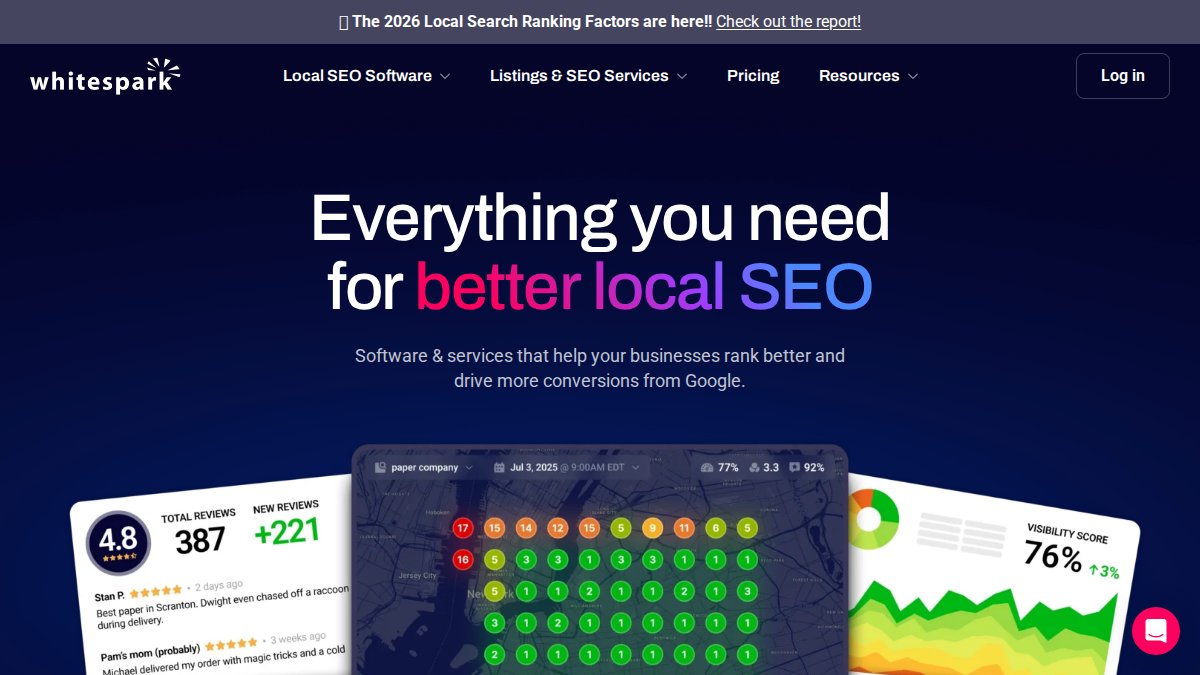
Whitespark splits its offering into two parts: the Local Citation Finder for discovery and a separate Listings Service for building. The Local Citation Finder starts at $33 per month as a subscription, while listings packages are one-time purchases. That separation is a feature, not a flaw, if you only need to find citation opportunities and handle submissions yourself.
The Local Citation Finder does one job well: it shows you where your competitors have citations that you do not. That competitive gap analysis is often more useful than a generic directory list, because it tells you which directories actually matter in your market.
The tradeoff is that you are buying two products if you want both discovery and submission.
Pros:
- Offers both a citation-finding tool and listings services
- Clear distinction between recurring software plans and one-time service packages
- Competitive gap analysis shows where rivals are listed
Cons:
- Listings services are separate from the monthly tool subscription
- Plan limits and directory coverage not detailed in available information
Best for: Businesses and agencies that want citation discovery software with the option to purchase listings services.
4. Yext, Moz Local, Uberall, Birdeye, and Search Atlas: Enterprise and Multi-Location Options
For multi-location businesses, the citation problem changes shape. A single-location plumber needs accuracy in a few dozen directories. A dental group with twelve offices needs synchronization across hundreds of listings, with location data that updates everywhere at once when a phone number changes.
Yext, Moz Local, Uberall, Birdeye, and Search Atlas all appear in comparisons of local citation and listing tools, and each approaches the problem differently. Yext focuses on centralized listings management. Uberall is associated with multi-location listing synchronization. Birdeye leans into reputation and presence. Moz Local serves established local SEO users. Search Atlas appears in roundups of citation services for agencies.
None of these platforms publish starting prices in the supplied data, so you will need to contact sales for a quote. That friction is itself a signal: these tools are built for organizations with a marketing team, not a solo operator.
| Platform | Primary Strength | Best Fit | Pricing Visibility |
|---|---|---|---|
| Yext | Centralized listings management | Enterprise brands | Contact sales |
| Moz Local | Established local SEO workflows | Existing Moz users | Contact sales |
| Uberall | Multi-location synchronization | Franchise networks | Contact sales |
| Birdeye | Reputation and presence | Review-driven businesses | Contact sales |
| Search Atlas | Agency citation services | Marketing agencies | Contact sales |
Do not assume a multi-location platform will fix a single-location problem. These tools add overhead that small businesses rarely need. If you have one or two locations, a focused citation tool plus consistent verification will outperform an enterprise suite you never fully configure.
Running a Local SEO Citation Audit: What to Check and How Often
A local SEO citation audit is the process of finding every place your business information appears online and checking whether it matches your correct name, address, and phone number. Run a full audit twice a year, and spot-check your top ten directories quarterly.
Here is the audit sequence we recommend:
- List your core data. Write down your exact business name, address, and phone number as they should appear everywhere. Decide on formatting now: “Suite 200” versus “Ste 200” matters to consistency.
- Search your business name plus city. Record every result that shows your information, including ones you never submitted to.
- Check the major platforms first. Google Business Profile, Bing Places, Apple Maps, and Yelp carry the most weight for local search and map rankings.
- Scan industry-specific and niche directories. These often drive referral traffic even when they do not affect rankings directly.
- Flag duplicates. Duplicate listings split your authority and confuse both customers and AI systems.
- Log inconsistencies. Note every wrong phone number, old address, or outdated business category.
- Fix at the source. Where possible, correct the data aggregator rather than the individual directory.
- Re-verify after 30 days. Some directories take weeks to propagate changes.
- Core business data documented in one place
- Business name plus city searched and results logged
- Google Business Profile, Bing Places, Apple Maps, and Yelp verified
- Industry-specific directories checked
- Duplicate listings identified
- Inconsistencies logged with screenshots
- Corrections submitted at source
- 30-day re-verification scheduled
For multi-location businesses, repeat this process for each location. Location data that is correct for one office is often wrong for another.
Local Citation Best Practices for 2026
Local citation best practices in 2026 start with one shift: citations are no longer just a directory problem. They are a data problem that feeds AI systems.
Prioritize accuracy over volume. A hundred accurate listings beat a thousand inconsistent ones. Every mismatch is a signal to search engines and AI systems that your data cannot be trusted.
Keep your categories tight. Wrong business categories push you into the wrong comparisons. A roofer listed under “general contractor” competes against a different set of businesses.
Monitor, do not just build. Citation monitoring catches drift before it costs you rankings. Businesses change phone numbers, move suites, and rebrand.
Think beyond directories. Social platforms and review sites also carry your business information, and AI systems pull from all of them. The Better Business Bureau’s guidance on business information accuracy offers a useful consumer-facing perspective on why consistency matters.
Measure outcomes, not activity. Track map rankings, local visibility, and referral traffic before and after citation work. If rankings do not move, the problem may not be citations at all.
The businesses that win local search in 2026 treat citations as living data, not a one-time project. Accuracy compounds; neglect compounds faster.
Citation management is only half the battle. Advanced Ranking Core® closes it with a proprietary Trust Gap® analysis, a multi-channel AI search strategy, and strategic oversight from experienced marketing professionals.
Frequently Asked Questions
Which tools are best for managing local citations?
The right tool depends on your size and workflow. BrightLocal combines citation tracking with building and rank tracking, starting at $29/month. Whitespark offers a dedicated Local Citation Finder from $33/month plus separate listings services. Advanced Ranking Core® adds AI search visibility monitoring across ChatGPT and Perplexity. For multi-location brands, Yext, Uberall, and Birdeye handle listing synchronization at scale, though pricing requires a quote.
What is the difference between citation building and listing management?
Citation building creates new listings on directories and niche sites, often as a one-time project. Listing management keeps existing profiles accurate and synchronized across platforms over time. Many tools offer both, but they are usually priced separately. Understand which you need before comparing prices.
How do I check whether my business listings are accurate?
Run a citation audit using a tool like BrightLocal’s Citation Tracker or Whitespark’s Local Citation Finder. These scan major directories and aggregators, flagging inconsistent name, address, and phone number (NAP) data, duplicate listings, and missing profiles. Check Google Business Profile, Bing Places, Apple Maps, Yelp, and industry-specific directories first. Re-audit quarterly, or monthly if you operate multiple locations.
Are local citation management tools worth it for small businesses?
Yes, if you rely on local search traffic. Inconsistent listings can suppress map rankings and confuse AI search tools that pull business data from multiple sources. Entry-level plans start around $29 per month, which is often less than the revenue lost from a single missed lead. Start with a citation audit, fix the highest-impact errors, then decide whether a paid tool or a managed service like Advanced Ranking Core® fits your budget.