

Table of Contents
- What Local SEO and AI Search Optimization Actually Are
- Local SEO vs AI Search Optimization: Key Differences
- AI Search Optimization for Local Businesses: What’s Different
- Local Business Structured Data for AI Search
- How to Optimize a Local Business for ChatGPT and AI Assistants
- AI Search Visibility Tools for Local Businesses
- Do Local Businesses Really Need Both Strategies?
- Measuring Success Across Local and AI Search
- Frequently Asked Questions
Last Updated: October 9, 2026
What Local SEO and AI Search Optimization Actually Are
When considering local SEO vs AI search optimization, they sound like they’re solving the same problem. They’re not. Understanding the difference is essential for local businesses that want to stay visible in 2026.
Local SEO focuses on helping your business appear in traditional search results tied to a specific location.
AI search optimization is newer and operates on different principles. When a customer asks ChatGPT, Perplexity, or Google’s AI Overviews “where should I take my dog for grooming,” the AI pulls from its training data and external sources to generate an answer.
At Advanced Ranking Core®, we’ve analyzed how local businesses appear in both channels. The gap between how you rank in Google Maps and how AI assistants perceive you is what we call the Trust Gap®.
The real challenge isn’t choosing between them. It’s that they require different strategies, different data, and different measurement approaches. Treating them as the same problem leaves money on the table.
Local SEO vs AI Search Optimization: Key Differences
The mechanics of how each system discovers and ranks businesses are fundamentally different.
Local SEO relies on signals Google has used for years: your Google Business Profile completeness, citation consistency across directories, review volume and sentiment, backlinks to your location pages, and on-page content relevance. A dentist in Denver with 200 five-star reviews, consistent NAP (name, address, phone) across the web, and a well-optimized Google Business Profile will dominate local pack results.
AI search optimization depends on whether AI models have encountered your business in their training data and whether they trust what they’ve learned about you. An AI assistant generating an answer pulls from web content, business listings, news mentions, social media, and other sources it was trained on. If your business appears in multiple trusted sources with consistent information, the AI is more likely to cite you.
Geographic Intent and How Each Approach Targets It
Local SEO targets geographic intent directly. A search for “roofing contractor Denver” signals intent to hire someone local. Google’s algorithm matches that intent by showing businesses in Denver with strong local signals.
AI search optimization also responds to geographic intent, but indirectly. When someone asks an AI assistant “I need a roofer in Denver,” the AI searches its knowledge base and external sources for information about Denver roofers. It then synthesizes that information into a recommendation. The AI doesn’t have a “local pack” to pull from, it has to recognize your business as a legitimate, trustworthy option based on how you appear across the web.
This creates a critical difference: local SEO is about being findable in a specific geographic market. AI search optimization is about being recognizable and trustworthy to AI systems that operate globally but can reference location-specific information when needed.
How AI Discovers and Recommends Local Businesses
AI systems discover local businesses through multiple channels. They crawl business directories, review sites, news articles, social media profiles, and industry websites. They also learn from their training data, which includes historical web content.
When an AI generates a recommendation, it’s making an inference based on patterns it learned. If it sees your business mentioned consistently across multiple sources with the same name, location, and service description, it gains confidence in that information. If it sees contradictory information, your phone number different on Google vs. Yelp, your service areas described differently on your website vs. your Google Business Profile, it becomes uncertain and may deprioritize you in recommendations.
This is where the Trust Gap® becomes critical. A business with perfect local SEO signals but fragmented information across platforms creates confusion for AI systems. The AI knows you exist, but doesn’t trust the details enough to confidently recommend you.
AI Search Optimization for Local Businesses: What’s Different
AI search optimization requires a multi-channel approach that goes beyond traditional local SEO. You’re not just optimizing one profile or one set of citations. You’re ensuring consistent, authoritative information about your business across every platform where AI systems might find you.
This includes your website content, Google Business Profile, industry directories, review sites, social media profiles, and any third-party mentions of your business. Each of these sources contributes to how AI systems understand who you are and what you do.
The emphasis shifts from rankings to recognition. In local SEO, you care about position, are you #1 in the local pack? In AI search optimization, you care about whether AI systems mention you at all, and whether the information they provide is accurate and complete.
For a local dental practice, this means ensuring that your expertise in specific treatments (cosmetic dentistry, implants, orthodontics) is documented consistently across your website, your Google Business Profile, industry directories, and any content you publish.
Local Business Structured Data for AI Search
Structured data is critical for AI search optimization. This is code embedded in your website and business profiles that tells AI systems exactly what information they’re looking at.
Schema markup for local businesses includes your business name, address, phone number, service areas, business hours, and services offered. It also includes review schema, which tells AI systems about your reputation, and article schema, which helps AI understand your expertise content.
Many local businesses have incomplete or missing structured data. Your Google Business Profile might list your services, but your website might not use schema markup to describe those same services. This inconsistency creates confusion for AI systems trying to build a complete picture of your business.
Proper structured data reduces ambiguity.
How to Optimize a Local Business for ChatGPT and AI Assistants
Optimizing for AI assistants requires a different mindset than traditional SEO. You’re not just optimizing keywords for search engines, you’re building a comprehensive, consistent online presence that AI systems can trust and understand.
Start with your website content. AI systems value detailed, specific information about what you do and who you serve.
Next, ensure consistency across all platforms. Your business name, phone number, address, and service descriptions should be identical on your Google Business Profile, your website, industry directories, Yelp, and any other platform where you appear.
Build content authority. AI systems are more likely to cite businesses that publish relevant, authoritative content. A dental practice that publishes articles about implant procedures, aftercare, and cosmetic dentistry options becomes a recognized authority in those areas.
Encourage reviews and citations. Reviews and mentions across trusted platforms signal to AI systems that your business is legitimate and well-regarded.
Audit your business information across 10+ platforms (Google Business Profile, Yelp, industry directories, social media, your website). Document every inconsistency in business name, phone, address, or service descriptions. These gaps are where AI systems lose confidence in your business.
AI Search Visibility Tools for Local Businesses
Measuring AI search visibility is harder than measuring Google rankings. There’s no “AI search console” that shows you exactly when and where you’re being cited by ChatGPT or Perplexity.
However, you can track several indicators. Monitor mentions of your business name across the web using tools that track brand citations. Check whether AI assistants mention your business when you ask them location-specific questions. Use Google’s Search Generative Experience to see what AI Overviews are showing for your local service keywords.
Advanced Ranking Core® reveals the Trust Gap® by comparing your local SEO visibility (where you rank in Google Maps) with your AI visibility (where AI systems mention you).
Without this measurement, you’re flying blind. You might be investing in AI optimization without knowing whether it’s actually improving your visibility to AI systems.
Do Local Businesses Really Need Both Strategies?
This is the question every local business owner asks. The answer depends on your market and your customers.
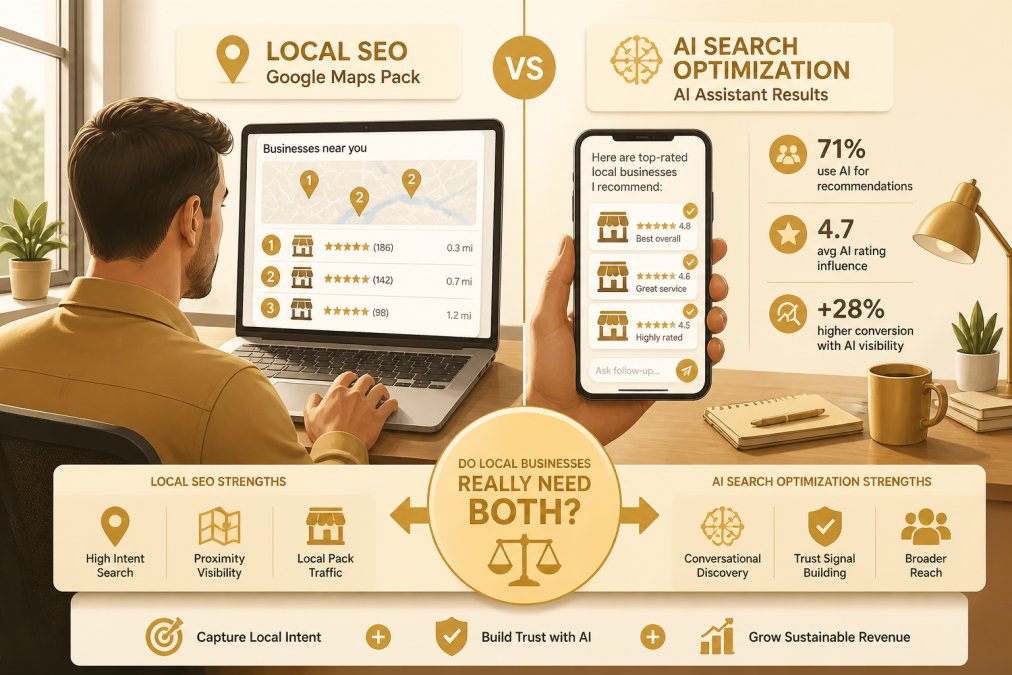
If your customers are still primarily using Google Maps and local search to find you, traditional local SEO is your priority.
But here’s what’s changing: more customers are using AI assistants to find local services. A homeowner asking ChatGPT “who’s the best roofer in my area” is getting an AI-generated recommendation, not a Google Maps result.
The safest approach is to optimize for both, but prioritize based on your market. If you’re in a competitive local market with high AI adoption (major cities, tech-forward demographics), AI search optimization becomes urgent.
The real risk is ignoring AI search optimization entirely. The market is moving in that direction. Waiting until your competitors dominate AI recommendations means playing catch-up later.
Measuring Success Across Local and AI Search
Success looks different in local search versus AI search, and you need separate metrics for each.
For local SEO, you track traditional metrics: your position in the local pack, the number of clicks from Google Maps, review volume and rating, and ultimately, phone calls and appointments from local search traffic. These are direct, measurable outcomes.
For AI search optimization, measurement is trickier. You can track:
- Brand mentions: How often does your business appear in AI-generated answers across different platforms?
- Citation accuracy: When AI systems mention you, is the information correct? Does it describe your services accurately?
- Visibility consistency: Are you being cited for the right keywords and service areas, or is the AI recommending you for unrelated searches?
- Lead attribution: Can you tie leads back to AI recommendations? This requires tracking where customers found you and asking about their discovery path.
The challenge is that AI citation data isn’t as straightforward as Google Analytics. You can’t see a direct “referred from ChatGPT” traffic source. Instead, you have to ask customers how they found you and monitor brand mentions across platforms.
| Metric | Local SEO | AI Search Optimization |
|---|---|---|
| Primary tracking | Google Maps position, clicks | Brand mentions, citation accuracy |
| Measurement method | Google Business Profile insights | Manual monitoring, brand tracking tools |
| Direct attribution | Easier (Google Analytics) | Harder (customer interviews) |
| Conversion path | Usually direct | Often indirect (AI mention → search → conversion) |
| Timeline | Weeks to months | Months to ongoing |
At Advanced Ranking Core®, we measure both channels to show you the complete picture of your search visibility. This reveals where you’re strong and where the Trust Gap® is costing you visibility.
Frequently Asked Questions
What is the difference between local SEO and AI search optimization?
Local SEO focuses on improving visibility in Google Maps, local pack results, and location-specific search results through citations, reviews, and geographic keywords. AI search optimization targets how AI assistants like ChatGPT and Perplexity discover and recommend your business by ensuring your information is accurate across platforms where AI systems gather data. Local SEO optimizes for map visibility and click-through rates; AI search optimization optimizes for being mentioned and cited in AI-generated answers.
Do local businesses need both local SEO and AI search optimization?
Yes. Local SEO remains essential for Google Maps visibility and traditional search results, where most local customers still search. AI search optimization is increasingly important because AI assistants are becoming a primary discovery channel, especially for service-based queries. A business that ranks in Google Maps but isn’t mentioned by ChatGPT or Gemini loses referral opportunities. Both strategies work together: strong local SEO builds the citations and reviews that AI systems use to verify and recommend your business.
How can a local business improve its visibility in AI Overviews and ChatGPT?
Ensure your business information is consistent and complete across Google Business Profile, industry directories, and structured data markup. AI systems gather information from multiple sources, so inconsistencies create the ‘Trust Gap’ that prevents AI from confidently recommending you. Write content that answers common customer questions in your service area, as AI systems cite authoritative, relevant content. Encourage authentic customer reviews and citations, which signal trustworthiness to AI systems. Finally, use tools designed to track and measure your visibility across AI platforms to identify gaps.
Is doing local SEO still worth it with AI search growing?
Yes. Local SEO remains worth the investment because Google Maps and local pack results still drive significant traffic and conversions for local businesses. AI search is growing but has not replaced traditional search. The real value is doing both: local SEO ensures you capture customers using Google Maps and location-based searches, while AI search optimization ensures you’re visible when customers ask AI assistants for recommendations. Ignoring either approach leaves revenue on the table.
The shift toward AI-driven search is real, but it doesn’t replace local SEO. Instead, it adds a new layer of complexity to how local businesses stay visible. The businesses that win in 2026 are those that optimize for both, ensuring they rank well in traditional search while building the trust and consistency that AI systems require. Get your Free Trust Gap® Analysis from Advanced Ranking Core® to see exactly where your business stands across both local and AI search channels.